Small Balcony Furniture Ideas: How to Choose for 30-100 Sq Ft
Pick balcony furniture that fits your square footage. 4-question audit, size-by-size setups, material lifespan, renter-friendly options for 10-100 sq ft.
TL;DR: Match balcony furniture to your square footage. Measure the slab first, leave 24 inches of walking space, size pieces down. Bistro sets fit 10-30 sq ft for $80-200; loveseat-and-table setups handle 30-60 sq ft for $300-700. Teak lasts 50 years; plastic resin only 5 (Today's Patio, 2025). 77% of US households underutilize their outdoor space (ICFA 2025), and the fix starts with sizing.
My first apartment balcony was 4 feet deep by 8 feet wide, total 32 sq ft, and I bought a 6-seat patio dining set off Wayfair the week I moved in. The pieces arrived on a Friday in October, took two hours to assemble, and would not fit through the sliding door once built. I had to disassemble, file a return, and pay restocking. The next attempt was a $40 IKEA bistro set, which fit, looked great, and lasted three years. The lesson cost me $180 and most of a Saturday: balcony furniture is a sizing decision before it is a style decision. If you have ever stood on a small balcony with a wrong-sized chair touching the rail and wondered if you should bail on the whole project, this guide is for you.
Small balconies are now standard inventory in American apartments. The US patio furniture market reached $21.2 billion in 2025 and is on track for $38.7 billion by 2035 at a 6.2% CAGR (Future Market Insights, 2025), and the research firm credits the growth specifically to "homeowners seeking flexible solutions for space limitations." Compact, modular, balcony-grade pieces drive that growth. The full balcony playbook (plants, food gardening, layout) lives in my small balcony garden ideas guide; this article does one job: picking furniture that fits and lasts.
The barriers are real but solvable. The International Casual Furnishings Association's 2025 Outdoor Trends Report (n=1,000 US adults, January 2025) found that 67% of consumers prioritize practicality and durability over style, and the two biggest non-money barriers to using outdoor space are cleaning (42%) and uncertainty about what to buy (34%). Money came after both. The dollar problem is solvable with realistic budgets; the "I do not know what fits" problem is what keeps small balconies empty. Over the next 3,500 words I will walk through the four-question fit audit, three size tiers with specific gear lists, material lifespan data that should drive every purchase, weight and wind safety on high-rise balconies, and three complete setups at $200, $500, and $1,200 budgets. Every recommendation is tied to research or current retail pricing.
Why Most Balcony Furniture Fails Before You Sit Down
Most balcony furniture disappoints because buyers shop by photo instead of square footage. ICFA's 2025 survey found that 85% of US households have outdoor space (porch, patio, balcony, or deck), but only 23% use that space as much as they would like (ICFA, March 2025). 77% of households are sitting on outdoor real estate they barely touch. The single fastest fix is sizing the furniture to the balcony before anything else.
The market data supports the urgency. The global outdoor furniture market reached $56 billion in 2025 and is projected to hit $92 billion by 2034 at 5.74% CAGR (Fortune Business Insights, 2025), with 59% of US consumers planning to buy outdoor furniture in 2025 and 39% planning multiple pieces (ICFA, 2025). A lot of that money will get wasted on pieces that do not fit. The folding furniture segment alone, which is the most balcony-friendly format, has grown from $4.42 billion in 2024 to a projected $7.61 billion by 2030 at 9.8% CAGR, with tables and chairs accounting for 51.9% of the segment (Grand View Research, 2025). Compact and modular formats are the ones winning.
The wellness payoff for getting it right is real. A peer-reviewed study published in Frontiers in Built Environment surveyed 700 apartment residents in Tehran during the COVID lockdown and found that residents with private balconies larger than 5 square meters (around 54 sq ft) and containing plants showed significantly lower scores on validated GHQ-12 and GAD-7 anxiety and depression scales than residents without that combination. A balcony you actually use lowers your stress; one you avoid does nothing. Sizing the furniture correctly is the difference between using the space and storing junk on it. For the privacy side of the same equation, my small balcony privacy ideas guide covers the screen-and-plant playbook.
The 4-Question Furniture Audit (Run Before You Buy)
Before any purchase, run a 10-minute audit on four variables: size, sun and rain exposure, wind, and lease or HOA constraints. Skip this and you will end up with the wrong piece returned three weeks later, like I did. The audit answers nine out of ten purchase questions automatically, and it costs nothing except a tape measure.
- Size in actual inches. Measure your balcony at the floor and at chair height. The footprint at chair height is the one that matters because most rails flare slightly, and chair backs have to clear them. Subtract 24 inches for walking space. Whatever is left is your usable furniture footprint. A 32 sq ft balcony with a 4 ft depth gives you maybe 18 sq ft of usable footprint after subtracting traffic.
- Sun and rain exposure. South-facing balconies in zones 5-10 cook fabric and bleach wood within two seasons. North-facing balconies stay wet and grow mildew on cushions. East and west are the kindest exposures, though east still gets morning condensation. Match material to exposure: teak and aluminum tolerate full sun; resin wicker holds up better in shade; powder-coated steel needs cover from direct south sun to avoid blistering paint.
- Wind exposure (the high-rise killer). Above the third floor, wind speed roughly doubles, and any furniture lighter than 15 pounds becomes a projectile in a storm. A 9 lb plastic chair on a 12th-floor balcony in 35 mph wind has happened to several of my friends. Check your floor; if you are above the third, your minimum chair weight is around 14 pounds, and your table needs anchoring.
- Lease, HOA, and condo rules. Many leases prohibit drilling into rails or anchoring to walls. Most HOAs limit colors visible from the street. Read your lease before you buy a fabric umbrella in turquoise. The renter-friendly section below covers the no-drill, no-anchor playbook.
Run the audit on a Saturday morning, write the answers on a sticky note, and shop with the note in hand. Every product page lists dimensions; cross-reference yours before you click buy. The 10 minutes I spend on this now saves me 3 hours of returns later.

Tiny Balconies (10-30 Sq Ft): The Bistro Setup
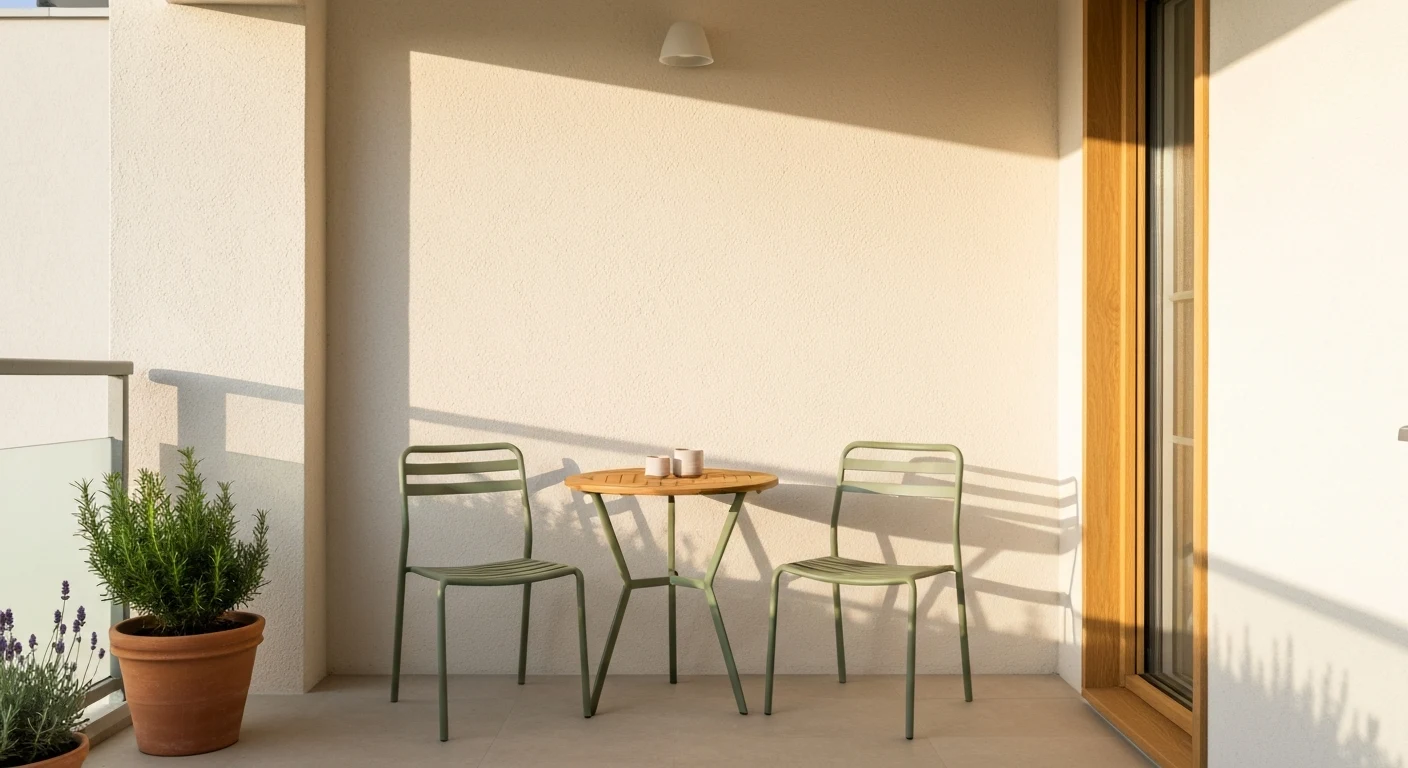
For balconies under 30 square feet, the only setup that consistently works is a two-piece bistro: one small round table (16-20 inch diameter) and two folding or stackable chairs. Anything larger blocks the door, and anything smaller looks lonely on the slab. The folding furniture segment grew 9.8% in 2024-2025 specifically because of urban renters with this footprint (Grand View Research, 2025), and a quality folding bistro set runs $80 to $200 retail at IKEA, Target, World Market, or Amazon.
My ranking of the formats that fit a tiny balcony, from most to least practical:
- Folding bistro set ($80-200). Powder-coated steel or aluminum frame, 18-inch round table, two folding chairs that store flat against a wall. The format renters and tiny-balcony owners should buy first because everything stows when the floor is needed for a delivery, a friend, or a weekly cleaning.
- Stackable bistro set ($120-280). Resin wicker or aluminum, slightly heavier than folding, with a more substantial look once set up. Stack the chairs against the wall when not in use. The trade is more comfort for less stowability.
- Single armchair plus side table ($150-350). If your balcony is closer to 10-15 sq ft and you live alone, a single comfortable outdoor armchair with a small side table beats a two-chair set you never both use. I made this swap in my second apartment and it changed how often I went outside.
Two pieces of advice from buying three of these over the years. First, the table should be round, not square. Round tables soften the visual mass on a small slab and let chairs tuck closer without arms catching on corners. Second, prioritize chair stowability over chair comfort. A folding chair you can hide against the wall when delivery comes is worth more than a heavy chair that lives in the way.

Add one large planter at the corner with a fragrant herb (rosemary, lavender, or basil) and one floor lamp or string-light kit, and the bistro corner is done. For the lighting half of the equation, the outdoor lighting guide for gardens and balconies covers the string-light and lantern playbook in more detail.
Small Balconies (30-60 Sq Ft): The Two-Seater Setup
Once you cross 30 sq ft, you have room for an actual sitting area: a two-seater loveseat or bench paired with a folding side table or low coffee table. The price band is $300-$700 for the full setup, and this is where most American apartment balconies land. The National Apartment Association reports that today's apartment balconies typically run 32 sq ft for studios up to 65 sq ft for one-bedroom layouts, with newer buildings averaging around 70 sq ft.
Three configurations that work for the 30-60 sq ft band:
- Outdoor loveseat plus folding side table ($300-650). A two-seater outdoor loveseat (typically 48-54 inches wide, 30 inches deep) with a 16-inch folding side table for drinks. Add weather-rated cushions and the setup reads finished. Loveseat materials in this band are usually powder-coated steel, resin wicker, or polywood.
- Bench plus two chairs plus low table ($400-700). The classic three-piece. A 4-foot outdoor bench against the longer wall, two chairs angled toward it, and a low coffee table or storage ottoman at center. Best for hosting because you can fit four bodies if you pull a chair from inside.
- Daybed or hanging chair plus small table ($400-800). The Pinterest favorite. A hanging egg chair (180 lb capacity, requires anchored ceiling beam, around $200-400) or a compact daybed with a low side table. Less practical for dining, ideal for solo coffee mornings or evening reading.
The folding side table is the underrated hero of this size. A 16-inch folding teak side table costs $40-80 and stores against the wall when you need the floor for a yoga mat or a packing box. Outdoor cushions are the other essential: the US outdoor cushion market grew from $446.7 million in 2024 toward $616.5 million by 2032 at 4.11% CAGR (Data Bridge Market Research, 2024), and a $30-50 set of Sunbrella-fabric cushions extends the seasonal life of an inexpensive bench by years.

One mistake I made early: I bought a full-depth outdoor sofa (38 inches deep) for a 4-foot-deep balcony, which left exactly 10 inches of walking space. Aim for outdoor furniture under 30 inches deep on any balcony less than 5 feet deep. Measure across the chair back to chair front, not the cushion seat alone. For the full play of using the same balcony for hosting, my guide to hosting in a small outdoor space covers the layout and serving side.
Larger Balconies (60-100 Sq Ft): The Conversation Setup
Balconies over 60 sq ft can support a real conversation grouping: a small outdoor sofa plus a chair plus a coffee table, or a sectional with an L-shape. The price band climbs to $700-$1,500 for a full setup with cushions. This is the territory where outdoor furniture starts to feel like indoor living, and the design payoff is real, though the trap is over-buying for a slab that still has a sliding door at one end.
Three layouts that fit 60-100 sq ft:
- Sectional plus coffee table ($800-1,500). An L-shape or U-shape modular outdoor sectional that hugs two walls of the balcony, leaving the open side for traffic. Modular pieces are critical here so you can reconfigure if the balcony shape is unusual. Outdoor sectionals in this band are typically polywood, powder-coated aluminum, or all-weather wicker.
- Sofa plus armchair plus coffee table ($700-1,300). The conversation triangle. A two-seat outdoor sofa against the long wall, a single armchair perpendicular, and a 30-inch coffee table at center. My preferred layout for a 70-80 sq ft balcony because it leaves room for one floor planter and a side table without crowding.
- Dining set plus lounge corner ($900-1,500). A 4-person folding outdoor dining set on one half of the balcony and a single lounge chair plus side table on the other. Best for renters who eat outside, which 55% of consumers report doing on upgraded outdoor space (ICFA, 2025).
For balconies in this size class, you have room for an outdoor rug. A 5x7 indoor-outdoor polypropylene rug ($60-150) anchors the seating area and turns the balcony into a defined "room" rather than a slab with chairs on it. Sunbrella-class outdoor fabrics, used on the rug and cushions, last 7-10 years in full sun, and the broader outdoor fabric market reached $13.41 billion in 2024 with growth to $17.54 billion projected by 2030 at 4.5% CAGR (Grand View Research, 2024).
The Material Guide: Lifespan, Weight, and Real Cost Per Year
Material choice separates a $200 balcony setup that lasts 3 years from a $200 setup that lasts 15. Most buyers underweight this. According to Today's Patio's manufacturer-warranty compilation (2025), teak outdoor furniture lasts 30 to 75 years (often 50+ with annual oiling), powder-coated aluminum lasts 15 to 25 years, all-weather wicker carries a 5 to 7 year warranty (10 with care), and plastic resin gives you 5. Translated to cost per year, a $400 teak bench amortizes at $8-13 per year, while a $150 plastic resin bench amortizes at $30 per year, and the plastic looks worse the whole time.
The material breakdown by use case:
- Teak ($300-1,200 per piece). The investment buy. 50+ year lifespan with annual oiling, weighs 25-40 lbs per chair (perfect for windy balconies), silvers to a patinated gray if you skip the oil. Worth it if you plan to stay in the apartment three or more years. Average teak unit price runs $500-820 (Cognitive Market Research, 2025).
- Powder-coated aluminum ($120-500 per piece). The best all-around choice for renters and movers. 20-year lifespan, weighs 8-15 lbs per chair, rust-resistant, comes in 50+ colors. The downside is that the lighter weight requires anchoring on high-rise balconies.
- Powder-coated steel ($90-350 per piece). Heavier than aluminum (15-25 lbs per chair), more storm-stable, but rusts at any chip in the powder coat. Best for low-floor balconies with cover.
- All-weather wicker ($150-700 per piece). Resin-wrapped synthetic that mimics rattan. Holds up 8-10 years in shade, faster degradation in full sun. Most comfortable of the budget options once cushions go on.
- Plastic resin ($25-120 per piece). Cheapest, lightest, fastest to fail. Cracks in cold, fades in sun, lasts 5 years. Acceptable as starter furniture or for renters who plan to leave inside two years.
If your budget is tight, buy aluminum chairs and a teak side table; the table is the most weather-stressed piece and chair stress is lower. The reverse split (steel chairs, resin table) is what most starter sets ship with, and the table fails first. Spend the materials budget where weather hits hardest.
Multifunctional Pieces That Earn Their Footprint
On a small balcony, every piece needs to do at least two jobs. Storage benches, ottoman-tables, and folding wall-mounted bars separate a usable balcony from a cluttered one. Multifunctional outdoor furniture is the single biggest growth driver in balcony-grade gear, and Future Market Insights flagged it as the primary force behind the $21.2 billion to $38.7 billion patio market growth projection for 2025-2035. The price premium for a dual-function piece is small enough that the value math is obvious once you do the footprint calculation.
Five pieces that pull double duty on a small balcony:
- Storage bench ($120-350). A 4-foot outdoor storage bench holds cushions, watering cans, hand tools, and seating for 2-3. Polywood or resin-wrapped models hold up best. The weight (35-60 lbs full) also wind-anchors the corner.
- Ottoman with hidden storage ($60-180). A 16-inch outdoor ottoman cube stores cushions in winter, doubles as an extra seat or a footrest, and triples as a side table with a tray on top. The cheapest dual-function piece by dollar.
- Folding wall-mounted bar table ($80-220). A 30-inch wall-mounted folding bar that drops down for happy hour and folds flat against the wall the rest of the time. Renters need to check lease drilling rules first; freestanding versions exist but cost more.
- Bench-planter combo ($180-400). A bench with planter boxes built into the back. The plants screen privacy from the side neighbor while the bench seats two. Saves the floor space that two separate items would eat.
- Expandable folding table ($90-280). A 24-inch table that folds out to 36 inches when guests come over. Critical if you sometimes host 4 people on a balcony built for 2. For the broader playbook of multifunctional pieces, my multifunctional furniture for small apartments guide covers the indoor side of the same logic.
The honest read on multifunctional furniture is that the worst pieces try to do four things badly and the best pieces do two things well. Skip the storage-bench-with-folding-table-and-built-in-cooler models; the hinges fail first and the cooler never gets used. A clean dual-function piece beats a confused four-function one every time.
Weight, Wind, and Safety: The High-Rise Reality
Balcony furniture safety is the section most guides skip, and it is the one that matters most if you live above the third floor. The International Building Code (IBC 2018, Section 1607.1) sets balcony live load at 60 pounds per square foot for residential balconies under 100 sq ft and 100 psf for larger or multi-family balconies. A standard 50 sq ft balcony at code can hold 3,000 to 5,000 pounds of furniture, plants, people, and snow load combined, but that is the engineering cap, not your safety target.
The wind problem is more urgent for high-rises. Above the third floor, average wind speed roughly doubles, and gusts in storms can hit 50-70 mph. Any unanchored furniture lighter than 15 lbs becomes a projectile in those conditions. Standard plastic resin chairs weigh 5-9 lbs; a typical balcony in Florida or coastal cities sees winds that lift those two or three times a year. The fix is a combination of weight, anchoring, and storage.
Three rules for high-rise balcony furniture safety:
- Minimum chair weight 14 lbs (above 3rd floor). Aluminum chairs with arms hit this; steel chairs almost always exceed it. Plastic resin under-weight chairs need stacking or storing inside.
- Anchor every table. Use a heavy umbrella stand (40-80 lb cement weight, $30-60) under the table center, or zip-tie table legs to the railing balusters. The table has the largest sail area of any piece on the balcony.
- Bring everything in for named storms. If the National Weather Service issues a warning above tropical storm strength, bring chairs and tables inside. Insurance does not cover liability for furniture that flies off your balcony and damages another unit.
The other safety check is railing load. Hanging planters, screen panels, and rail-clamp tables put concentrated load on the railing system, which is rated separately from the floor. Most residential railings handle 50 lbs of horizontal load per linear foot. A 4-foot rail panel with a row of 25 lb hanging planters is approaching that limit; spread the load along the rail instead of clustering one section. If you have any doubt, the building manager has the engineering plans and can give you an answer in 10 minutes.
Renter-Friendly Setups (No Drilling, No Anchors)
Most apartment leases prohibit drilling into rails or walls, and many HOAs limit visible color choices. The fix is a renter playbook that uses weight, freestanding pieces, and tension-fit hardware instead of permanent anchors. Done right, the balcony reads finished, and the day you move out, you take everything with you.
Six no-damage tactics that have worked across three different rentals for me:
- Freestanding screen pole instead of wall-mounted. Use a heavy planter base (40-50 lb cement-filled) as the foot for a vertical pole that holds curtains or a small canopy. Zero drilling required.
- Zip-tie attachment to rail balusters. Black UV-rated zip ties through existing balcony rail balusters hold privacy screens, hanging planters, and even string lights without touching paint or wood. Replace ties annually because UV degrades them.
- Tension rod for outdoor curtains. A 6-8 ft outdoor tension rod ($25-50) installs corner-to-corner across the open side of the balcony with zero hardware in the wall. Pair with weighted-hem outdoor curtains.
- Furniture protector pads to prevent floor scratches. Small felt or rubber pads under chair legs prevent the deposit-eating scratches on composite balcony floors. The $5 pack saves $200 on move-out.
- Stand-alone pergola kit (no roof attachment). A freestanding aluminum pergola kit ($300-800) sits on its own four feet, leaves no marks, and holds shade cloth or string lights. Disassembles in 30 minutes for moving day.
- Roll-up bamboo screens with rail clips, not staples. Most renters staple bamboo screens to the rail; the staples leave dents. Use rail-clamp clips instead, $8 for a 10-pack.
For the broader no-drill, no-damage philosophy that extends inside the apartment too, my renter-friendly wall decor guide covers the indoor playbook.

Three Complete Setups by Budget ($200, $500, $1,200)
Here are three complete balcony furniture setups at three real-world budgets, with specific item types and price ranges drawn from current retail at IKEA, Target, World Market, Wayfair, and Amazon. All three can be assembled in one weekend and require zero drilling or wall damage.
Setup 1: Bistro Starter ($150-200). One folding bistro set ($80-120) in powder-coated steel with cream cushions, one small terracotta planter with rosemary or basil ($25-40), one outdoor floor lamp or string-light kit ($40-60), and a 2x3 indoor-outdoor doormat ($15-25). Total footprint: 12 sq ft. Time to set up: 90 minutes. Best for tiny balconies and first-time renters who want a finished corner without committing.
Setup 2: Two-Seater Comfort ($450-650). One outdoor loveseat in resin wicker or polywood ($250-400), one 16-inch folding teak side table ($60-90), one outdoor storage ottoman with cushion lid ($80-140), one Sunbrella-class cushion set ($40-60), and one freestanding plant stand with three pots ($60-100). Total footprint: 28 sq ft. Time to set up: 2 hours. The setup most apartment dwellers should aim for; it pays back in usable evenings within two weeks.
Setup 3: Conversation Lounge ($1,000-1,500). One modular outdoor sectional in polywood ($600-900), one 30-inch outdoor coffee table in teak or aluminum ($120-220), one 5x7 indoor-outdoor polypropylene rug ($80-150), two large 24-inch terracotta or fiberglass planters with shrubs or olive trees ($100-200), and one freestanding aluminum pergola or 8x8 sail shade ($150-300). Total footprint: 50 sq ft. Time to set up: 3 hours. The setup that turns the balcony into a true second living room.
The setup that pays back fastest is whichever one you use within the first month. ICFA's 2025 data shows 72% of people with upgraded outdoor space use it to relax and unwind, and 55% eat al fresco. Both activities need a chair you want to sit in and a table that holds a coffee or a plate, in that order. Pretty rarely matters as much as comfortable.
Frequently Asked Questions
What size table fits a small balcony?
For balconies under 30 sq ft, a 16-20 inch round bistro table is the only size that consistently leaves room for two chairs and walking space. For 30-60 sq ft balconies, a 24-30 inch round or square table works. Above 60 sq ft, a 30-36 inch table seats four. Always measure floor space minus 24 inches of walking space before buying.
What is the best outdoor furniture material for a windy balcony?
Powder-coated steel and teak are the two top picks for windy balconies above the third floor. A typical steel chair weighs 15-25 lbs, and teak runs 25-40 lbs per chair, both well above the 14 lb minimum that resists projectile risk in a 35 mph gust. Avoid plastic resin chairs at any height; they weigh 5-9 lbs and become projectiles in storms.
How long does outdoor furniture last?
Lifespan depends entirely on material. Today's Patio's manufacturer warranty data (2025) shows teak lasts 30-75 years (often 50+ with annual oiling), powder-coated aluminum 15-25 years, steel 15 years if undamaged, all-weather wicker 5-10 years, and plastic resin 5 years. Cost per year is what matters, and teak almost always wins on that math.
Can my balcony hold a sectional sofa?
Most can, structurally. Residential balcony live load per IBC 2018 Section 1607.1 is 60 psf for spaces under 100 sq ft, meaning a 50 sq ft balcony handles 3,000 lbs of combined load (furniture, plants, people). A typical 4-piece outdoor sectional weighs 200-400 lbs, well within that. The real constraint is door access and walking clearance, not weight.
What is the best balcony furniture for renters?
Folding aluminum bistro sets, freestanding pergolas, zip-tie attached privacy screens, and tension-rod outdoor curtains are the four formats that work without drilling, anchoring, or wall damage. The Grand View Research folding furniture report (2025) attributes 9.8% annual segment growth specifically to renters and small-space dwellers picking these formats over fixed installations.
Should I cover or store my balcony furniture in winter?
Storage beats covering when possible. Bringing cushions and lighter pieces inside extends their life by 2-3 years. For pieces too heavy to move, weather-rated furniture covers ($30-80) keep moisture and snow off and add 3-5 years to lifespan. Teak handles winter without cover; everything else lasts longer with one.
Picking balcony furniture comes down to four moves: measure first, match material to your floor and exposure, weight-check for wind, and pick pieces that do at least two jobs each. Get those right and a 30 sq ft balcony becomes a functional second room rather than empty rental real estate. ICFA's 2025 finding that 67% of consumers prioritize practicality and durability over style is the right instinct; the prettiest balcony chair is the one you sit in next Saturday morning. For the lighting and atmosphere half of making the space hostable, the biophilic design guide for small apartments covers how plants, light, and natural materials change how a small space feels.
Affiliate Disclosure
Some links on this page are affiliate links. If you purchase a product through these links, I may earn a small commission at no additional cost to you. Thank you for your support!
Tags

Written by Joesp H.
Interior Design & Small Space Living Specialist
Former marketing manager turned full-time home optimizer. After living in 7 homes ranging from 450 to 2,000 sq ft, I started CleverSpaceSolutions to help people create organized, functional spaces on real budgets.
Other Articles
Small Balcony Privacy Ideas: How to Block Out Neighbors and Build a Private Outdoor Retreat
25 renter-friendly small balcony privacy ideas: bamboo screens, plant walls, outdoor curtains, pergolas. Block neighbors, dampen noise, stay HOA-compliant.

Biophilic Design for Small Apartments: How to Create a Living Green Corner
Turn your small apartment into a calming green sanctuary. Practical biophilic design tips, plant picks by light level, renter-friendly mounting, and budget breakdowns from $10 to $1,200.
30 Renter-Friendly Wall Decor Ideas for Small Apartments (No Holes, No Damage)
Discover 30 renter-friendly wall decor ideas that need zero holes. Command strips, peel-and-stick wallpaper, leaning art, and more. Protect your deposit.