How to Create a Stylish Entryway When Your Apartment Doesn't Have One
5 renter-friendly entryway setups for apartments with no foyer. Console tables, floating shelves, bench-and-hooks, bookshelf mudrooms, and rug-defined entries from $5 to $100.
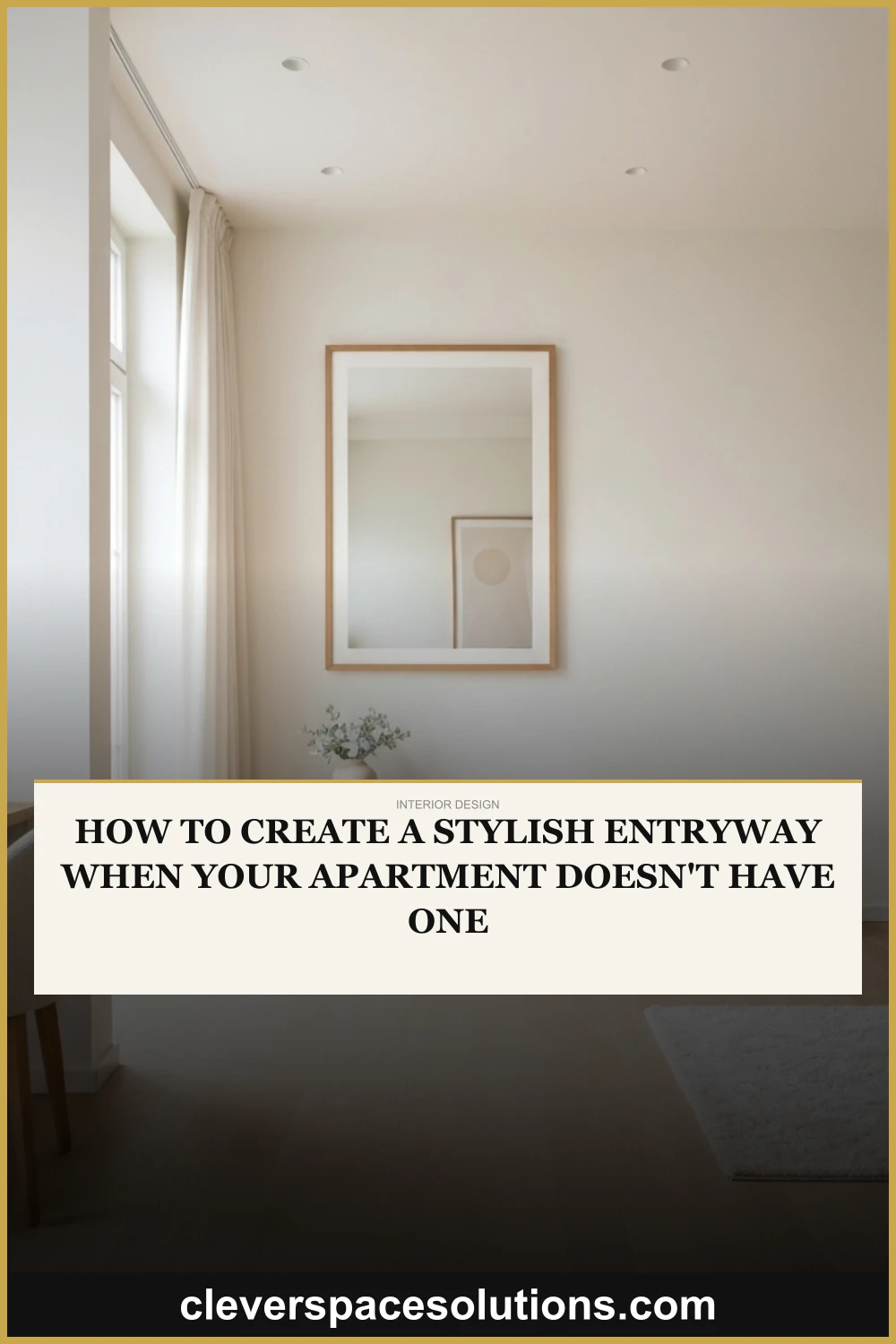
The average American apartment is just 908 square feet (RentCafe, 2025). Studios? 457 square feet. One-bedrooms? 735 square feet. And those two unit types make up 52.7% of all newly built apartments in the country. So when builders are cutting space, guess what gets eliminated first? The entryway.
I moved into my first apartment and walked straight from the front door into the living room. No hallway, no closet, no transition space. My shoes ended up in a pile, my keys disappeared daily, and every time I came home, the first thing I saw was chaos. It took me three apartments to figure out that you do not need a foyer to have an entryway. You just need to build one yourself.
This guide covers five practical entryway setups for apartments that have zero dedicated entry space, from console tables and floating shelves to full bookshelf mudroom alternatives. Every method here is renter-friendly, budget-conscious, and tested in real small apartments.
TL;DR: Americans spend 2.5 days per year looking for lost items like keys and shoes (Pixie Survey, 2017). A defined entryway, even a DIY one, solves that. This guide walks through five apartment entryway setups: the console table entry (open floor plans), the floating shelf landing zone (tight spaces), the bench-and-hooks hallway (narrow corridors), the bookshelf mudroom (families), and the rug-defined entry (studios). Budget tiers from $35 to $300, all damage-free, all portable for your next move.
Why Every Apartment Needs a Defined Entryway
This is not just about aesthetics. There is real science behind why a cluttered doorway makes your entire apartment feel worse.
A UCLA study of 60 dual-income couples found that women who described their homes as "cluttered" or "full of unfinished projects" had elevated cortisol (the stress hormone) levels throughout the entire day. People in tidy, organized homes showed declining cortisol, meaning they actually relaxed when they got home (Saxbe & Repetti, 2010). Your entryway is the first thing you see when you walk in. If it is a pile of shoes and jackets, your brain registers disorder before you even set your bag down.
Here is what I have learned from setting up entryways in four different apartments: the entryway is not really about storing your stuff. It is about creating a boundary between outside and inside. When you walk through the door and there is a hook for your coat, a tray for your keys, and a spot for your shoes, you are performing a micro-ritual. You are telling your brain: I am home now. Skip that ritual and you carry the outside stress right to your couch.
The economics back this up too. Americans collectively spend $2.7 billion annually in replacement costs for lost items, and the average person loses 2.5 days per year searching for things like keys, phones, and wallets (Pixie Survey, 2017). A landing zone by your front door with a key hook and a small tray eliminates the single most common source of morning frustration in small apartments.
The market reflects this need. The global entryway furniture market is valued at $5.3 billion in 2026 and projected to reach $7.8 billion by 2035, growing at 4.5% annually (Business Research Insights, 2026). The home organization market is even larger, hitting $13.27 billion globally in 2025 (The Business Research Company, 2025). Manufacturers are building entire product lines for people who need organized entry spaces in apartments that were not designed with one.
Before You Start: Reading Your Apartment Layout
Before you buy anything, stand at your front door and look at what you are working with. Most apartments without entryways fall into one of three layouts:
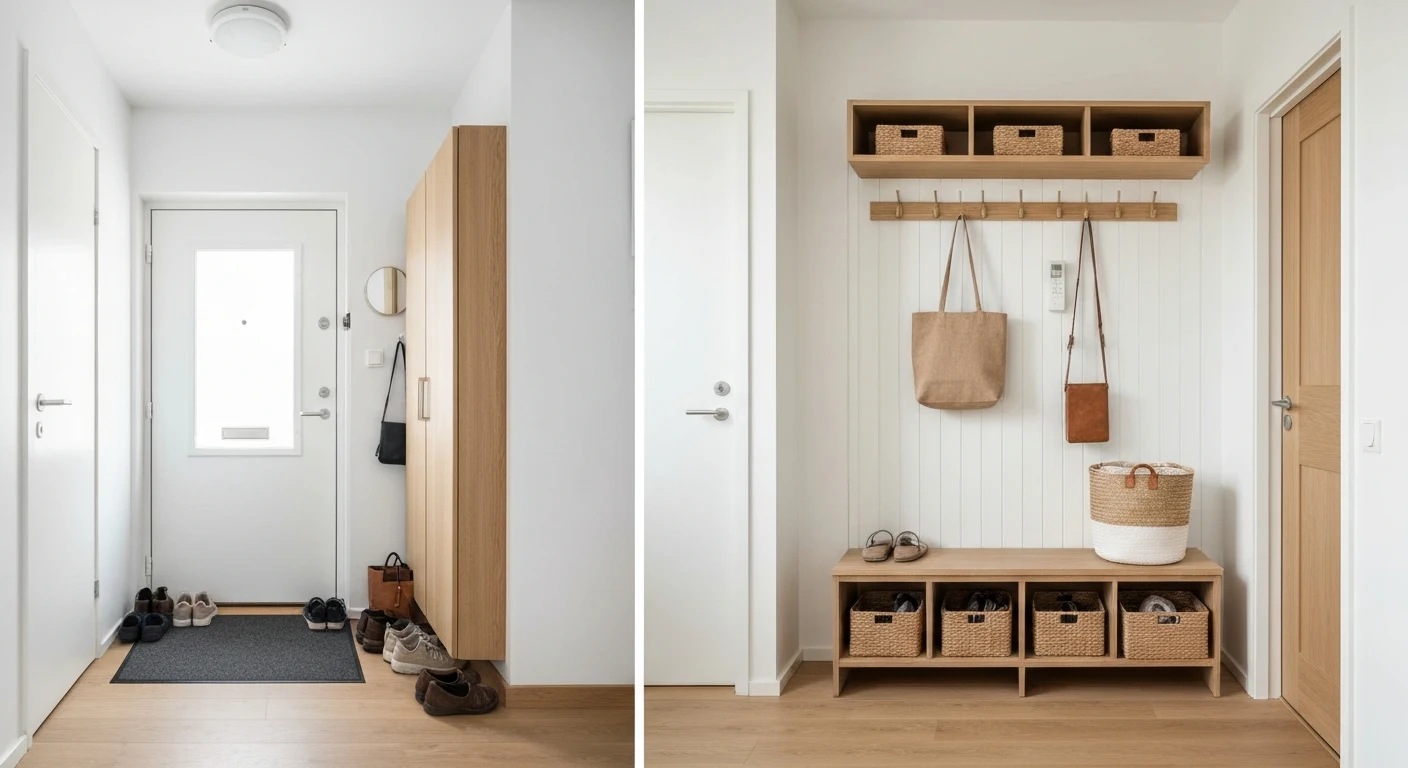
The open floor plan: You walk in and you are immediately in the living room. There is wall space on either side of the door but no corridor. This is the most common layout in studios and modern one-bedrooms. Your best option here is a console table or floating shelves to define the entry zone visually.
The narrow hallway: You have a corridor between the door and the main room, but it is too narrow for furniture. This is typical in older apartment buildings and pre-war layouts. Wall-mounted hooks and a slim bench (under 12 inches deep) are your tools here.
The L-shaped entry: The door opens into a small area that turns into the kitchen or living room. You have a corner to work with. This is actually the easiest layout because you can tuck a bookshelf mudroom into that corner and create a real transition zone.
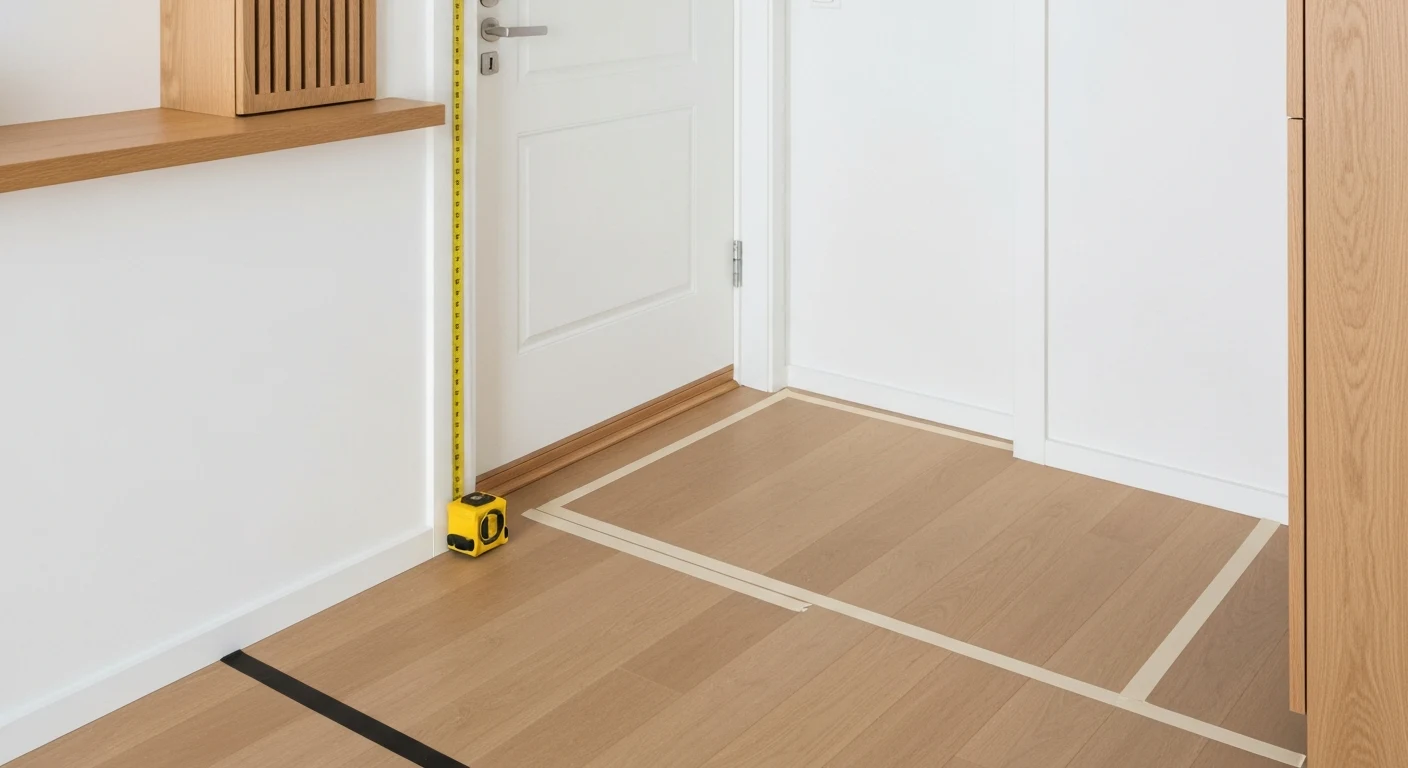
Measure the width of your available space. If you have less than 30 inches, stick with wall-mounted solutions. Between 30 and 48 inches, you can fit a narrow console or bench. Over 48 inches? You have room for a full bookshelf setup. Knowing your measurements before shopping will save you from the most common small-apartment mistake: buying furniture that technically fits but blocks the walkway.
Setup 1: The Console Table Entryway (Best for Open Floor Plans)
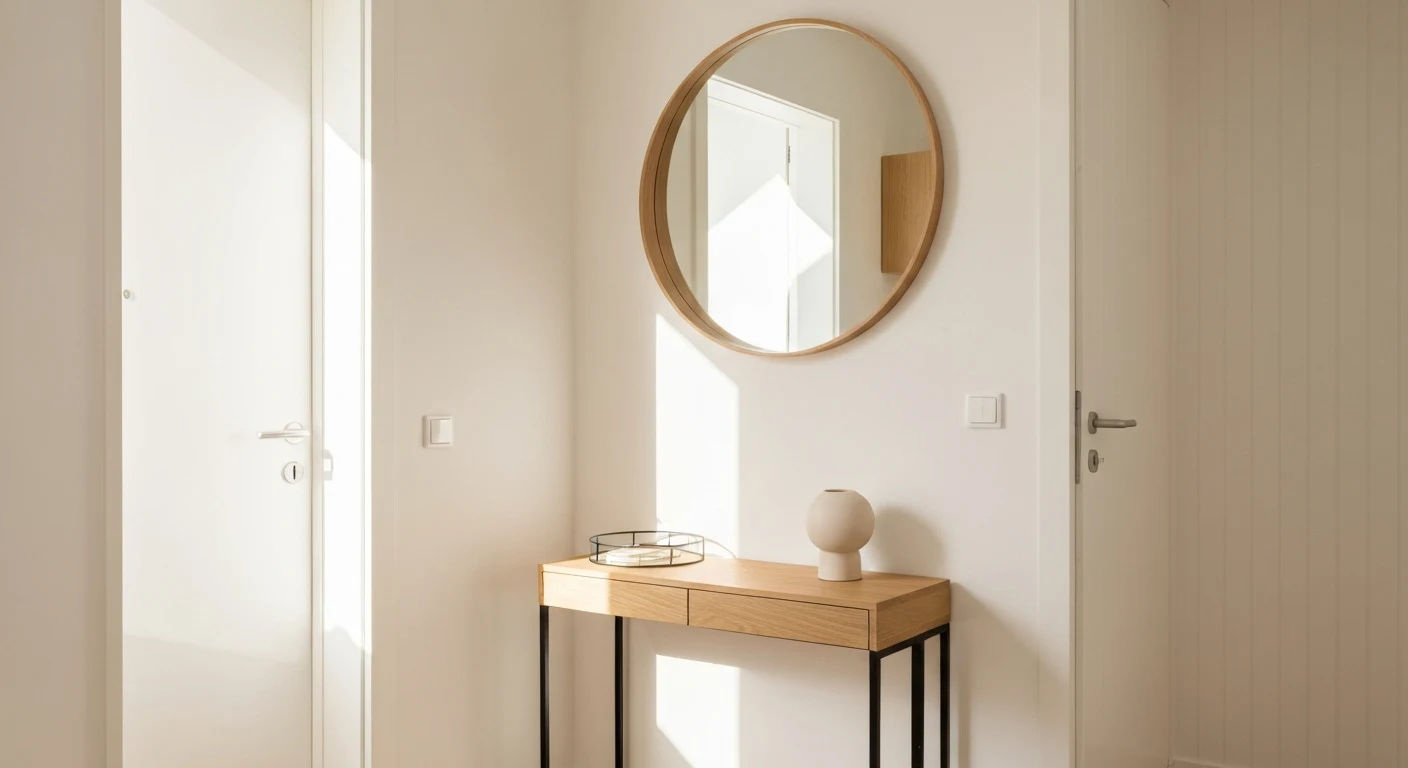
If your front door opens directly into the living room, a console table is the simplest way to carve out an entryway. I use this setup in my current apartment and it completely changed how the space feels when I walk in.
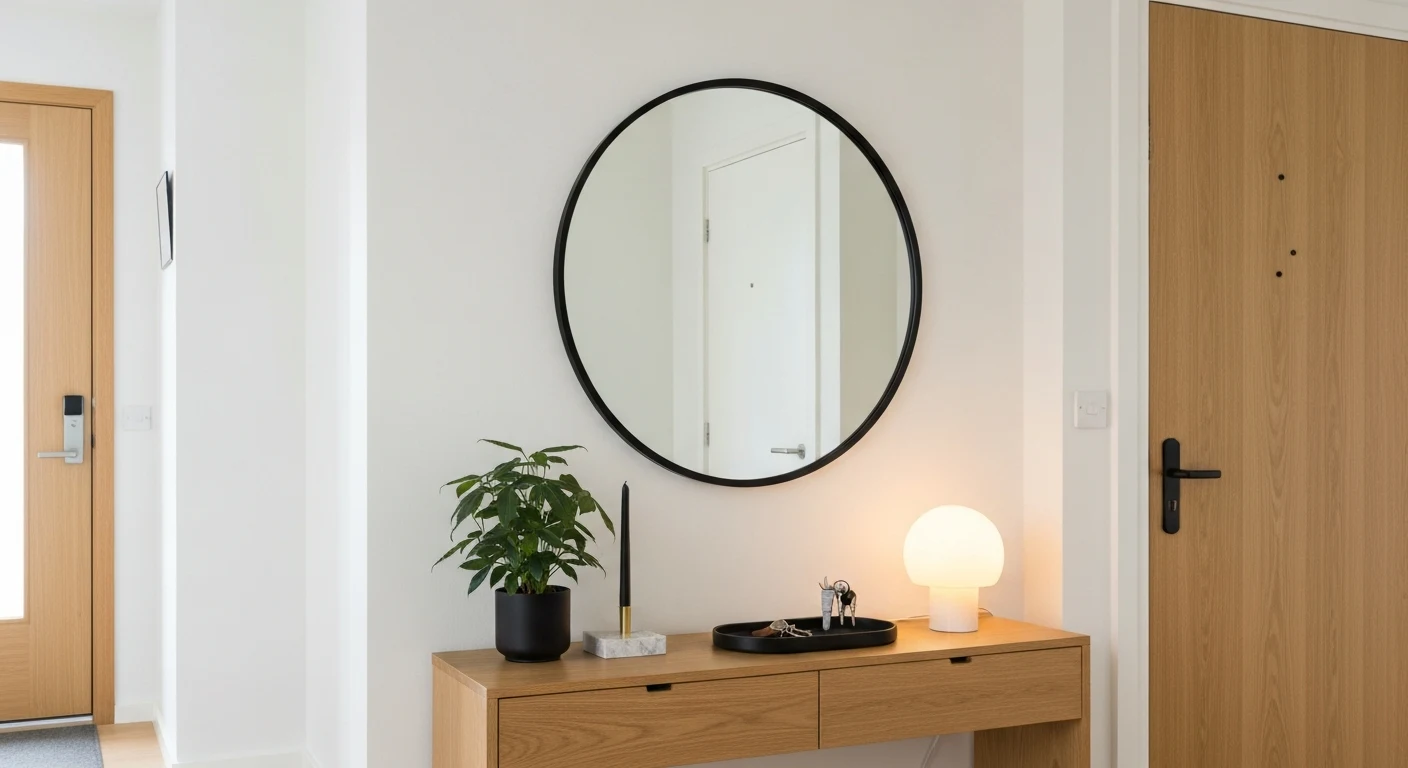
The trick is choosing a table that is narrow enough to not block traffic but substantial enough to feel intentional. I recommend 10 to 14 inches deep and no wider than the wall space beside your door. A table that is too small looks like an afterthought. Too large and it becomes an obstacle.
What to put on your console table
Keep it functional first, decorative second. The essentials: a catch-all tray or small bowl for keys and change, a small lamp or battery-operated light for ambiance, and one decorative item (a plant, a candle, or a small framed photo). Resist the urge to overcrowd it. The power of a console table entryway is in its restraint.
Above the table, hang a mirror. This is not optional. A mirror near the front door serves three purposes: it gives you a last-minute check before leaving, it bounces light into what is usually the darkest part of the apartment, and it creates the visual illusion of depth in a space that needs to feel larger. A round mirror between 20 and 30 inches in diameter works best for most apartment entryways.
Storage underneath
The space under a console table is prime storage territory. A pair of woven baskets can hold shoes, scarves, or reusable bags. If you use a table with a lower shelf, even better. That shelf becomes your shoe staging area. The goal is to keep floor-level items contained and invisible from standing height.
Budget: A basic console table runs $40 to $120. Add a mirror ($15 to $50), a tray ($8 to $15), and two baskets ($10 to $25 each). Total setup: $73 to $210.
Setup 2: The Floating Shelf Landing Zone (Best for Tight Spaces)
When floor space is non-negotiable and every inch counts, go vertical. A floating shelf (or two) mounted 48 to 54 inches from the floor gives you a landing zone without taking up any floor space at all.
This is the setup I recommend most for studio apartments where a console table would eat into already-limited square footage. One shelf, 24 to 36 inches wide, with adhesive hooks below it. That is your entire entryway.
The landing zone formula
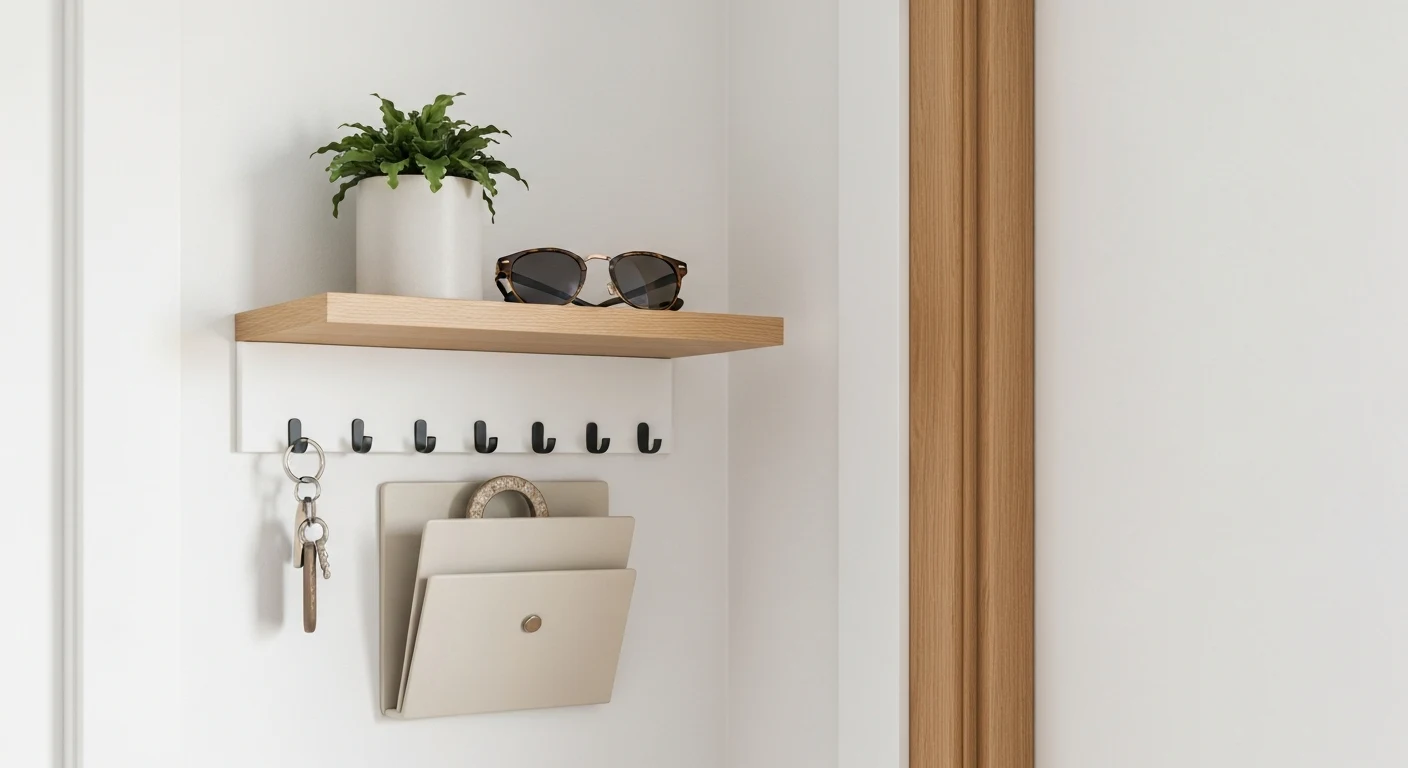
Install the shelf at chest height so you can drop items on it naturally when you walk in. Below the shelf, mount 3 to 5 adhesive hooks spaced 4 inches apart. Use renter-friendly adhesive strips rated for 5+ pounds each. Above the shelf, hang a small mirror or a piece of art to signal "this area is intentional."
On the shelf itself: a small dish or tray for keys, a narrow basket or bin for mail, and one plant (pothos or snake plant work great because they tolerate low light near doorways). That is it. Three items. The shelf is small, and a cluttered shelf defeats the entire purpose.
Making it renter-friendly
Command brand now makes adhesive-mounted floating shelves rated for up to 5 pounds. For heavier items, look for tension-mounted shelves or over-the-door organizers that do not require any wall attachment at all. In a 2025 Rently survey of 500 renters, 45% said they refresh their space by rearranging furniture and 32% do DIY projects (Rently, 2025). A floating shelf entryway is one of the highest-impact DIY projects you can do in under 20 minutes.
Budget: Adhesive floating shelf ($12 to $35), adhesive hooks ($6 to $12), small mirror ($10 to $25), tray ($5 to $10). Total setup: $33 to $82.
Setup 3: The Bench and Hooks Hallway (Best for Narrow Corridors)
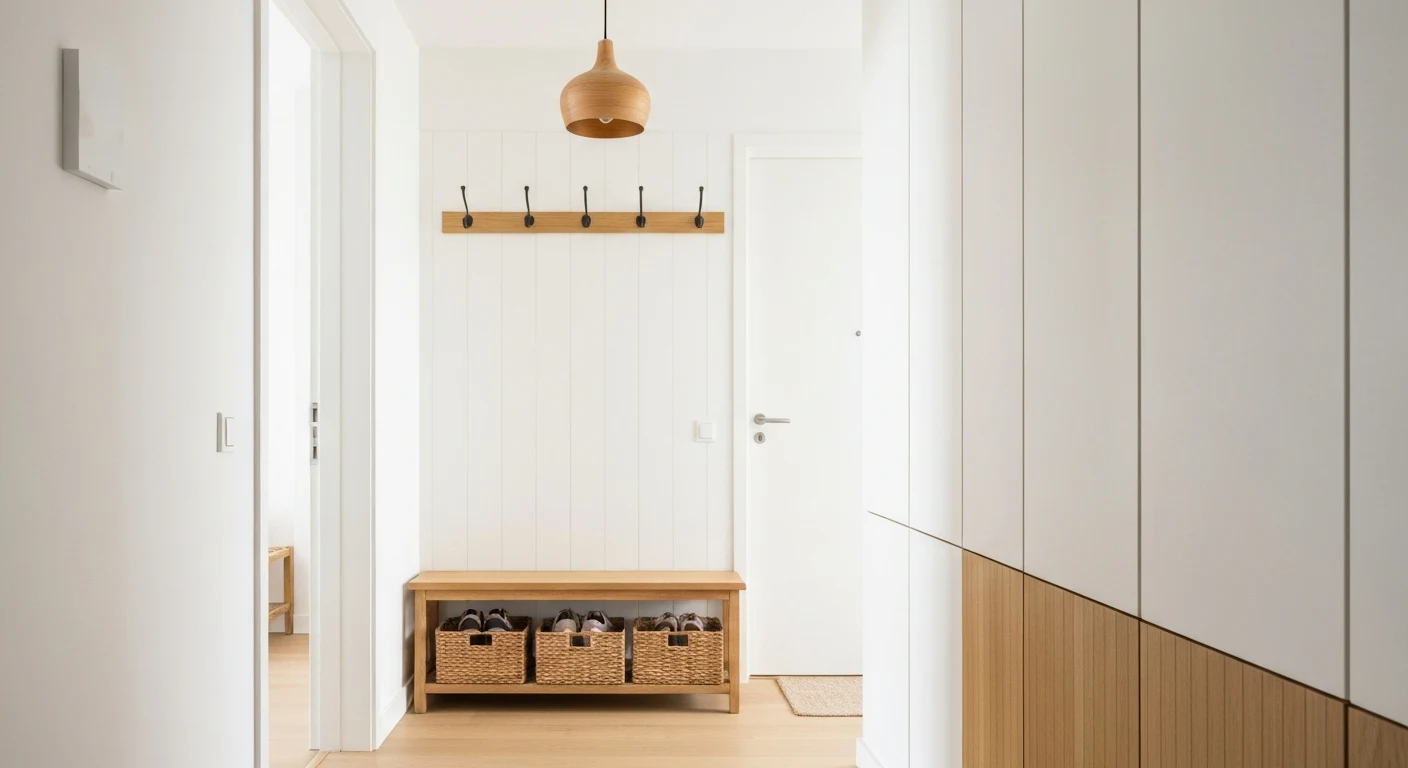
If you have a hallway between your front door and the main room, even a short one, a slim bench with hooks above it creates the most functional entryway setup.
The key measurement is depth. Most apartment hallways are 36 to 42 inches wide. A bench should be no more than 14 inches deep to leave at least 22 inches of walking clearance. That sounds tight, but 22 inches is the minimum comfortable passage width according to most interior design standards.
Choosing the right bench
Skip the decorative benches that look great on Instagram but offer no storage. You want a bench with either open shelving underneath (for shoe baskets) or a flip-top lid (for hidden storage). The storage bench is doing double duty: it is your shoe rack and your sitting spot for putting shoes on. That dual function is what makes small spaces actually work.
Here is a reality check on shoe storage: the average American woman owns 19 pairs of shoes and the average man owns 12 (KURU Footwear, 2023). You are not going to fit all of them by the door, and you should not try. An entryway bench holds 3 to 4 pairs in active rotation. The rest go in a closet. The goal is capturing the shoes you actually wore today, not building a shoe museum.
Wall hooks above the bench
Mount a row of 4 to 6 hooks 60 to 66 inches from the floor (high enough to clear seated heads, low enough to reach comfortably). Adhesive hooks work for lighter items like scarves and hats. For coats and bags, use over-the-door hook racks or freestanding coat racks if your lease prohibits wall mounting.
One thing I have found matters more than people expect: spacing. Hooks crammed too close together create a tangled mess. Space them 6 to 8 inches apart. If you only have room for 4 hooks, that is better than 6 hooks fighting for the same 20 inches.
Budget: Storage bench ($45 to $150), adhesive hooks or hook rail ($10 to $30), 2 baskets ($15 to $30). Total setup: $70 to $210.
Setup 4: The Bookshelf Mudroom (Best for Families and Shared Apartments)
This is the heavy-duty option. If you live with roommates, have kids, or have a pet, a single hook and a tray will not cut it. You need dedicated storage for multiple people, and a bookshelf-turned-mudroom delivers exactly that.
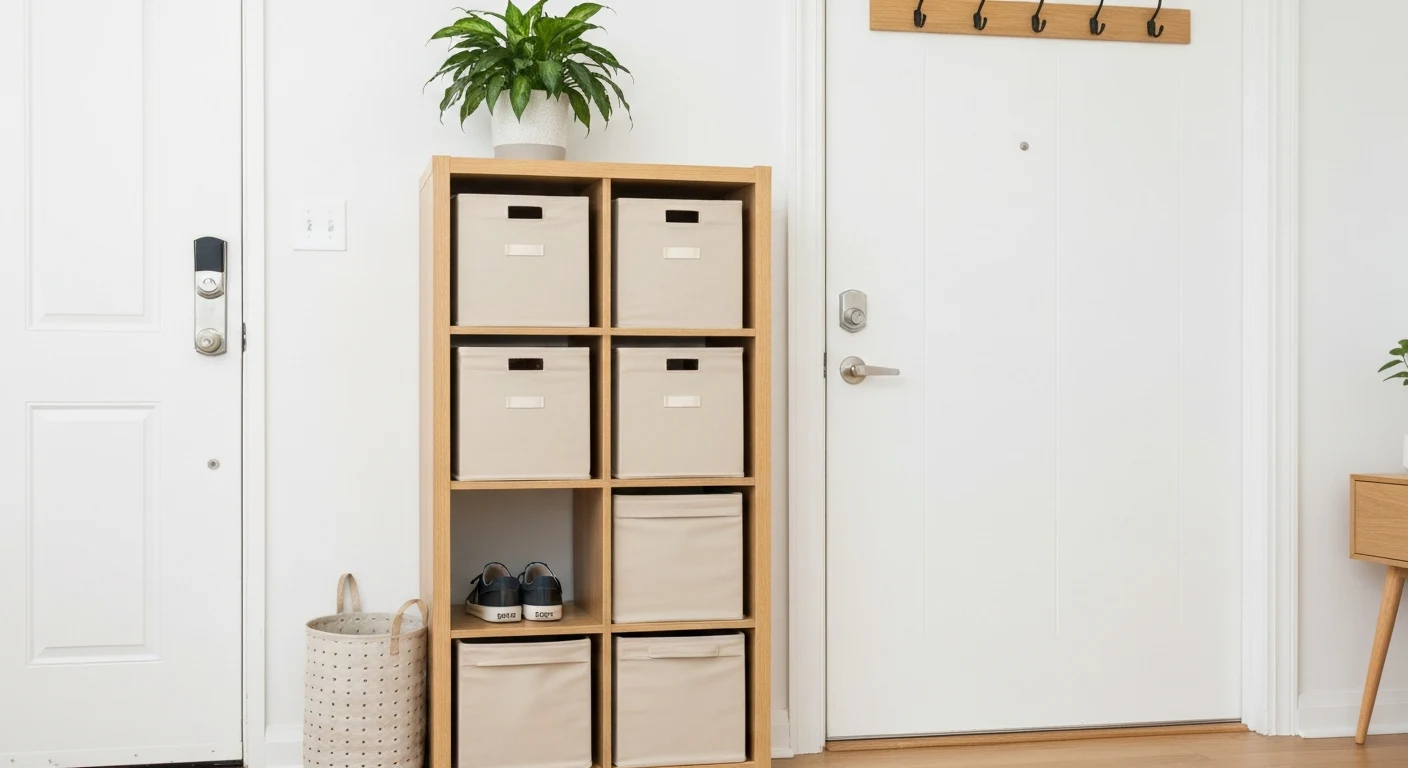
The concept is simple: take a cube storage unit (like a Kallax or similar), turn it on its side if needed, add baskets and hooks, and you have a modular mudroom that fits in a 36-inch-wide space. Each person gets their own cubby for shoes, bags, and personal items. No mixing, no arguing, no pile by the door.
Setting it up
Position the unit as close to the front door as your layout allows. If you have an L-shaped entry, tuck it into the corner. If you are working with an open floor plan, the bookshelf itself becomes a room divider, creating the entry zone structurally rather than just visually.
For a household of 2 to 3 people, a 2x4 cube unit works perfectly. That gives you 8 cubbies: 2 per person for shoes and bags, plus 2 shared cubbies for things like pet leashes, umbrellas, and reusable shopping bags. Label the cubbies if you live with roommates. It sounds excessive, but labeled cubbies stay organized. Unlabeled cubbies become a second junk drawer within a month.
Mount hooks above the bookshelf or on the wall beside it for coats and bags. If you are using the unit as a room divider, attach hooks to the side panel facing the door.
Why this works for renters
Cube storage is completely freestanding. No wall mounting required. It moves with you. In a Redfin analysis of Census data, 25.6% of renters moved within the last 12 months, and among Gen Z renters, that number jumps to 52.4% (Redfin, 2024). Your entryway solution needs to be portable. A bookshelf mudroom disassembles in 15 minutes and fits in any moving truck.
Budget: 2x4 cube storage unit ($35 to $80), 4 to 6 fabric bins ($20 to $40), hooks ($10 to $20). Total setup: $65 to $140.
Setup 5: The Rug-Defined Entry (Best for Studio Apartments)
Sometimes the best entryway is one you create with nothing more than a rug and intentional placement. In studio apartments where every piece of furniture is visible from every angle, a rug near the front door tells both you and your guests: this is where the apartment begins.
Choose a rug that is 2x3 or 3x5 feet, depending on your available space. It should be large enough to stand on while taking off your shoes but small enough to not blend into the rest of the room. A different texture or color from your main area rug creates the visual boundary. For advice on choosing the right rug for small spaces, I wrote a separate guide.
Layering the zone
The rug alone is not enough. Pair it with at least one vertical element to give the zone height and presence. A freestanding coat rack, a tall narrow mirror leaning against the wall, or a slim plant stand all work. Without a vertical element, the rug just looks like a rug. With one, it reads as a designated area.
If you want to take it further, add a small wall-mounted shelf or adhesive hooks directly above the rug zone. The combination of a rug below and a shelf above creates a visual "frame" around your entryway. It is the same principle interior designers use for styling empty corners: define the zone from floor to ceiling, and the eye reads it as intentional space.
53% of Gen Z and 52% of millennials say they are willing to choose a smaller home with higher-quality products and finishes rather than a larger home with fewer features (NAHB, 2025). That mindset extends to how they style small apartments too. A well-curated entry zone made of quality pieces can elevate a 500-square-foot studio more than an extra 200 square feet of empty space.
Budget: Entry rug ($15 to $45), freestanding coat rack or mirror ($20 to $60), adhesive shelf ($12 to $30). Total setup: $47 to $135.
Styling Tips That Make Any Setup Look Intentional
No matter which setup you choose, these styling details separate a "nice try" from a "this looks like it was always supposed to be here."
Light the zone
Entryways in apartments are almost always the darkest part of the space because they are farthest from windows. Fix that. A small battery-operated puck light ($5 to $10) under a shelf or inside a cubby, a table lamp on a console, or an adhesive-mounted wall sconce all work. In the 2025 Rently survey, 79% of renters said they prefer soft, layered lighting (Rently, 2025). Your entryway is the perfect place to start layering.
Add a mirror
I keep saying this because it keeps being true: a mirror near the door does more work than any other single piece. It expands the visual space, adds light, and gives you a practical reason to pause at the entryway. Round mirrors feel softer and work well in small spaces. Full-length mirrors work if you have the wall space and want to make a dark area feel more open.
Use one scent anchor
Place a small candle (unlit for safety), a reed diffuser, or a bundle of dried eucalyptus at your entryway. Scent is the strongest sense tied to memory, and having a consistent scent at your door creates an immediate "home" association when you walk in. I keep a small rosemary plant on my console table. It serves double duty as decor and scent.
Keep surfaces 70% empty
The biggest mistake I see with DIY entryways is overloading them. A console table with 15 items on it looks like a storage problem, not a design choice. Follow the 70% rule: 70% of any surface should be empty or near-empty. A tray, a plant, and a lamp is enough. Three items, clear space around each one. That restraint is what makes it look designed rather than cluttered.
Budget Breakdown: Three Tiers for Every Wallet
With 44.6 million renter households in the U.S. (iPropertyManagement, 2025) and 38% of renters budgeting between $101 and $500 for decor refreshes (Rently, 2025), an entryway project fits comfortably within most budgets. Here is what each tier looks like:
Under $50 (The Minimalist): Adhesive floating shelf ($15), adhesive hooks ($8), small tray ($5), entry rug ($15). This gives you a functional landing zone with zero floor space used and zero wall damage. Best for tight budgets and ultra-small studios.
$50 to $150 (The Sweet Spot): Narrow console table ($60), round mirror ($25), two baskets ($20), key tray ($8), small lamp ($15). This is the setup I recommend most. It covers all essentials (keys, shoes, coats, visual anchor) without overcommitting on either space or money.
$150 to $300 (The Full Mudroom): Storage bench ($100), cube storage unit ($50), 4 fabric bins ($25), hook rail ($15), area rug ($25), mirror ($30), accent lamp ($20). This is the bookshelf mudroom setup with a bench added. It works best in shared apartments where multiple people need organized entry storage. Consider this your one-bedroom apartment upgrade that roommates will actually thank you for.
Shoe Storage Solutions for the Entryway
Let me be direct: shoes are the number one reason apartment entryways fail. You come home, kick them off, and suddenly there are 6 pairs sprawled across the floor. Before discussing storage, let me put the problem in perspective.
The average American owns 12 to 19 pairs of shoes, and we buy about 4 new pairs per year, spending roughly $240 annually on footwear (KURU Footwear, 2023). Your entryway should hold 3 to 5 pairs in rotation. The rest belong in a closet or under-bed storage.
Best shoe storage options by space
Under 12 inches of depth: A slim shoe rack that holds 3 to 4 pairs vertically. These lean against the wall and take up about 9 inches of floor space. Under $20 at most retailers.
Under a console table: Two flat baskets or a small shoe tray. Keeps shoes corralled and hidden from standing height.
Inside a storage bench: This is the cleanest solution. Shoes go inside, lid closes, and your entryway looks tidy. Most benches hold 4 to 6 pairs.
Over-the-door shoe organizer: Not glamorous, but effective. Hang it on the inside of your front door or a nearby closet door. Holds 12+ pairs and costs $8 to $15. If organization is about systems, not aesthetics, this is the most space-efficient shoe solution available.
Renter-Friendly Installation: Keeping Your Deposit Safe
Every setup in this guide is designed to be damage-free. But here are the specific techniques I use to make sure nothing marks the walls:
Command strips and hooks: Apply to clean, dry walls. Wait 1 full hour before hanging anything. Do not use on textured walls, freshly painted surfaces (wait 7 days after painting), or wallpaper. When removing, pull the tab straight down, never outward.
Freestanding furniture: Use felt pads on the bottom of all furniture legs to protect flooring. This includes console tables, benches, and bookshelf units. A $3 pack of felt pads prevents hundreds of dollars in floor damage.
Rugs on hardwood: Always use a rug pad underneath. It prevents slipping and protects the floor finish from friction. A non-slip rug pad costs $8 to $15 and is reusable across multiple apartments.
For more damage-free wall solutions, I wrote a comprehensive guide to 30 renter-friendly wall decor ideas that covers every adhesive and mounting method in detail.
And remember: 33.6% of renters now stay in the same home for 5+ years (Redfin, 2024). If you are one of them, investing time in a proper entryway setup pays off for years, not months.
Frequently Asked Questions
How do you create an entryway in an apartment that opens directly into the living room?
Place a narrow console table (10 to 14 inches deep) against the wall nearest the door. Add a mirror above it, a tray for keys on top, and baskets underneath for shoes. The console table acts as a visual boundary between the entry zone and the living area. For studios, a rug placed at the door with a freestanding coat rack creates the same effect without any furniture against the wall.
What is the best entryway setup for a studio apartment?
The rug-defined entry or the floating shelf landing zone. Both take up minimal to zero floor space. A 2x3 rug near the door paired with adhesive hooks and a small wall shelf gives you key storage, coat hanging, and a visual entry zone for under $50. Avoid bulky furniture in studios since floor space is more valuable than storage in spaces under 500 square feet.
How much does it cost to set up an apartment entryway from scratch?
A basic setup starts at $33 to $50 (adhesive shelf, hooks, tray, and rug). A mid-range console table setup runs $100 to $150. A full bookshelf mudroom with storage bench costs $150 to $300. The median renter decor budget is $101 to $500 per refresh (Rently, 2025), so even the most complete entryway setup fits within one seasonal budget cycle.
Can you create an entryway without damaging rental walls?
Yes. Every method in this guide is damage-free. Use Command strips and adhesive hooks for wall-mounted items (rated for 5+ pounds each), freestanding furniture for floor pieces, and felt pads on all furniture legs. Avoid nails, screws, and heavy-duty anchors entirely. When removing adhesive products, pull tabs straight down following manufacturer directions to prevent paint damage.
What should you keep at your apartment entryway?
Keep only daily-use items: keys, wallet, 2 to 3 pairs of current-rotation shoes, your most-used jacket, and a bag or backpack. Everything else (seasonal coats, dress shoes, rarely used accessories) should be stored in a closet. The entryway is a staging area for what you grab on the way out, not a closet overflow zone. Follow the rule of keeping surfaces 70% empty for a clean, intentional look.
More from Studio & Small Apartment
Layout, decor, and life in studio and small apartments.
How Do You Decorate a Studio Apartment?
Wondering how to furnish your studio apartment without it feeling cramped? This guide answers your questions with smart ideas for zoning, furniture, and deco...

How to Decorate a Studio Apartment: An Expert's Guide
8 min read

How Do You Decorate a Studio Apartment?
10 min read

The Art of Studio Living: Your Complete Guide
10 min read
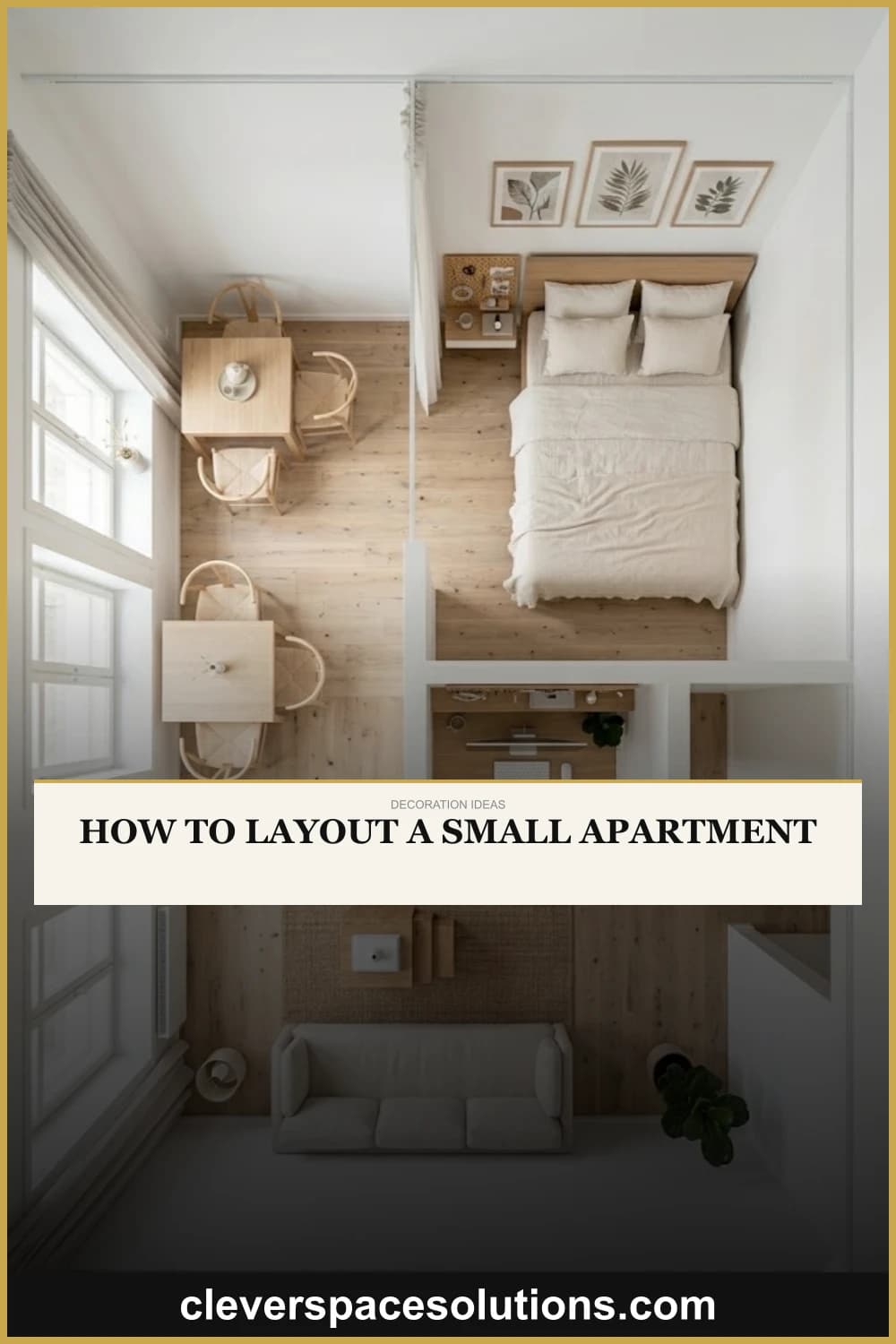
How to Layout a Small Apartment?
25 min read
3 Flawless Layouts and 5 Real-Life Studio Solutions
21 min read
How Do You Decorate a One-Bedroom Apartment?
18 min read
Tags

Written by Joesp H.
Interior Design & Small Space Living Specialist
Former marketing manager turned full-time home optimizer. After living in 7 homes ranging from 450 to 2,000 sq ft, I started CleverSpaceSolutions to help people create organized, functional spaces on real budgets.
Other Articles
How Do You Decorate an Apartment for Halloween?
Looking for renter-friendly Halloween decor ideas? Discover how to decorate your apartment with damage-free hacks, space-saving tricks, and stylish themes.
Small Bedroom Storage Ideas When You Have No Closet Space
Creative storage solutions for small bedrooms without closets. From under-bed drawers to open closet systems, organize any bedroom on a budget.
How to Create a Cozy Reading Nook in a Small Apartment (No Spare Room Required)
Create a cozy reading nook in a small apartment with no spare room needed. A chair, a lamp, one shelf — and reading just 6 minutes cuts stress by 68%. Here's how.