Small Kitchen Storage Ideas When You Have No Cabinet Space
Storage hacks for kitchens under 100 sq ft: a 5-minute audit, eight dead zones to attack, and three complete renter setups at $75, $300, or $800.
TL;DR: Most US apartment kitchens give you 6 to 10 linear feet of cabinets for 50 to 100 square feet of room (RentCafe, 2025). The fix is not more cabinets, it is using the walls, the doors, the inside of every cabinet, and a $40 rolling cart. Pull-out drawer inserts run $40 to $100 per drawer installed (Angi, 2026) and recover roughly 40% of dead vertical space. NKBA's 2026 trends report found 70% of homeowner remodel requests now lead with "smarter storage" over square footage. This guide gives you a 5-minute audit, eight storage zones to attack, and three complete setups at $75, $300, and $800.
My first apartment kitchen was 70 square feet with six linear feet of upper cabinets, two narrow base cabinets, and a single drawer that stuck when humid. I moved in with eight cardboard boxes of kitchen stuff and got through three of them before I ran out of shelf. The rest lived on the floor by the radiator for a month while I figured out the problem. The problem turned out to be obvious: I was buying organizers for the cabinets I had instead of building storage on the walls, doors, and ceiling I was ignoring. If you have ever stood in your own kitchen at 11 p.m. holding a stand mixer and a stack of cutting boards with nowhere to put either, this guide is the playbook I wish I had at 25.
The math behind the problem is real. RentCafe's 2025 analysis of Yardi Matrix data across the 100 largest US rental markets found that studio apartments now average 457 square feet (up from 444 in 2023), one-bedrooms average 735 square feet, and two-bedrooms 1,097 square feet. Inside those footprints, the kitchen usually pulls 50 to 100 square feet, with cabinet linear footage that has not kept pace. The full small-kitchen playbook (layout, lighting, color, appliance choice) lives in my stylish small kitchen ideas pillar guide; this article does one job: pulling more storage out of a kitchen the builder under-equipped.
Why Your Apartment Kitchen Has So Few Cabinets (It's Not Your Imagination)
Apartment kitchens shrank deliberately over the last decade. Builders responded to rising land and labor costs by squeezing every square foot, and the kitchen took the biggest hit because it has the highest per-foot fitout cost (cabinets, plumbing, appliances). RentCafe found that studios added 13 square feet on average from 2023 to 2024, but most of that gain went to bedrooms and bathrooms, not kitchens. A 50 square foot studio kitchen with one base cabinet, one upper, and a 24-inch range is a typical new-build floor plan in any major metro area in 2026. The US Census Bureau's Q1 2026 Housing Vacancies and Homeownership Survey put the homeownership rate at 65.3%, meaning roughly 45.3 million US households rent, a record high. 45 million households are working with kitchens they cannot remodel.
The renter math compounds the problem. Renters cannot install cabinets, cannot drill new mounting holes without losing a deposit, and cannot replace a 1990s-era spice rack with a custom pantry pull-out. The Houzz 2026 US Kitchen Trends Study (1,620 homeowners surveyed) found 94% of renovating homeowners integrate specialty storage features like pull-out waste bins (64%), tray dividers (55%), spice drawers (41%), and cutlery dividers (38%), and 47% add a dedicated pantry cabinet. Renters do not have that option, which means three out of four owner-occupied kitchens get the storage upgrade you cannot.
StorageCafe's December 2024 to February 2025 National Self Storage Survey (n=2,824 respondents) confirms the pressure: 33% of Americans currently rent a self-storage unit, and one-bedroom apartment dwellers are the heaviest users at 44%. When a third of one-bedroom renters pay $70 to $200 a month to store stuff offsite, the in-home storage gap is real and measurable. Closing it inside the kitchen is the highest-leverage move because the kitchen is where stuff piles up fastest.
The 5-Minute Storage Audit (Run Before You Buy Anything)
Before you buy a single rail or rolling cart, run a 5-minute audit. Most renters skip this and end up with three pegboards stacked in a closet because they bought the trendy thing without measuring the wall. The audit costs nothing and answers six of the eight purchase questions automatically. Run it on a Saturday morning with the cabinets empty.
- Empty the kitchen onto the counter. Every cabinet, every drawer, the floor of the pantry, the top of the fridge. Pile it on the counter or the dining table. You will be surprised how much is in there.
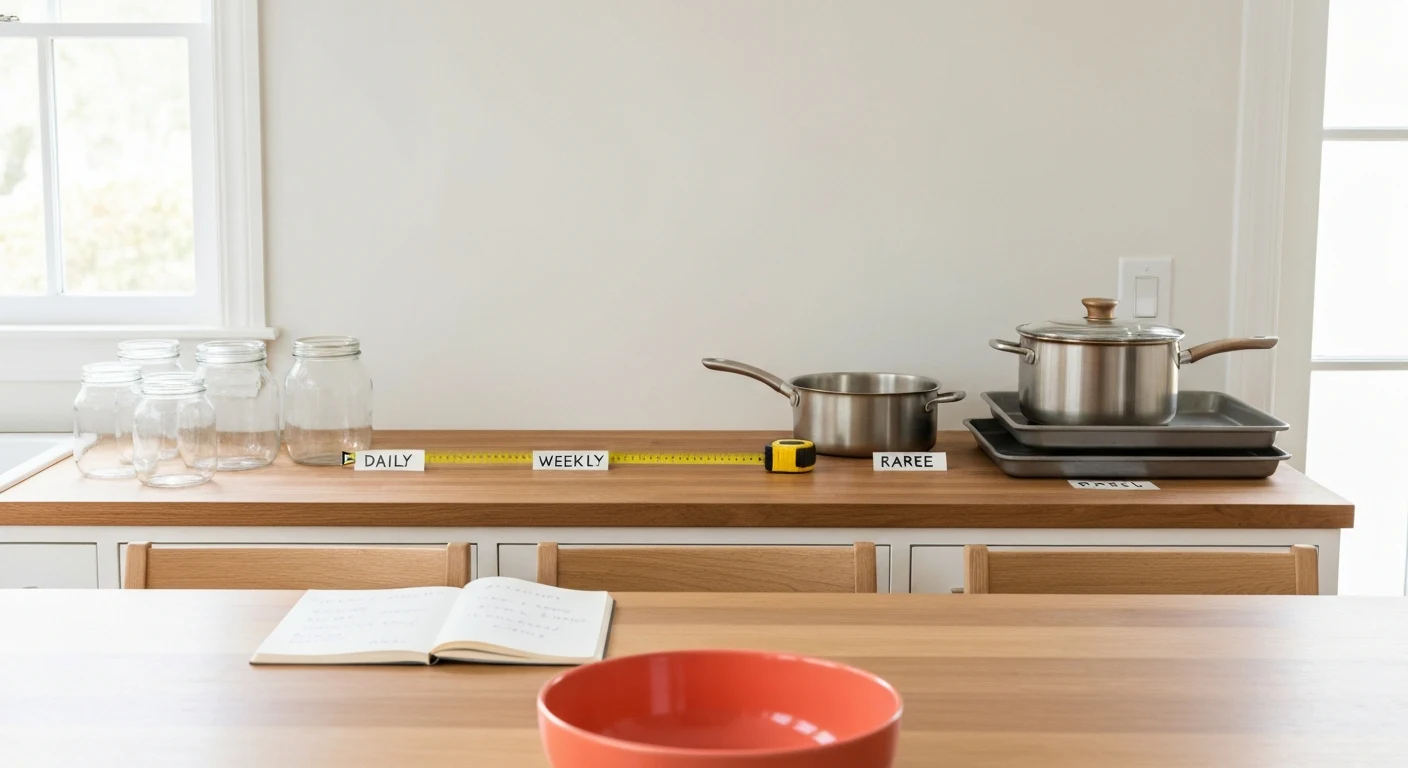
- Sort by frequency. Three piles: daily (coffee mug, plates, knife, cutting board), weekly (mixer, baking sheet, pasta pot), and rarely (turkey roaster, ice cream maker, the salad spinner you used twice in 2024). Daily items get the prime real estate at chest height. Rarely items go up high or in deep corners.
- Measure linear feet of usable space. Walk around the kitchen with a tape measure: total counter run, total upper cabinet linear feet, total base cabinet linear feet, unused wall surface (anywhere there is no cabinet or appliance), and inside-of-door surface area. Write the numbers on a sticky note.
- Photograph every dead zone. The corner of the upper cabinet that nothing reaches, the space above the fridge, the toe kick, the inside of every cabinet door, the side of the fridge facing the wall. These are the eight zones renters waste most.
- Lock in three buckets. Daily-access stays at counter or chest height. Weekly-access goes on walls (rails, hooks, pegboards) or on a rolling cart. Rarely-access goes high (above-cabinet shelf, top-of-fridge bin) or low (back of base cabinet behind a pull-out).
The audit takes 5 minutes after the cabinets are empty. The reason it matters is in the data: a 2017 Pixie Lost & Found Survey (still the standard benchmark) found Americans spend 2.5 days a year searching for misplaced items at home, costing US households a collective $2.7 billion annually in replacement costs. About 10 minutes a day disappears looking for things in disorganized spaces. The kitchen is the room where that hits hardest because cooking is time-sensitive. An organized kitchen gives those 10 minutes back, and the audit is what makes everything else stick.
Vertical Storage: The Wall Space Renters Forget
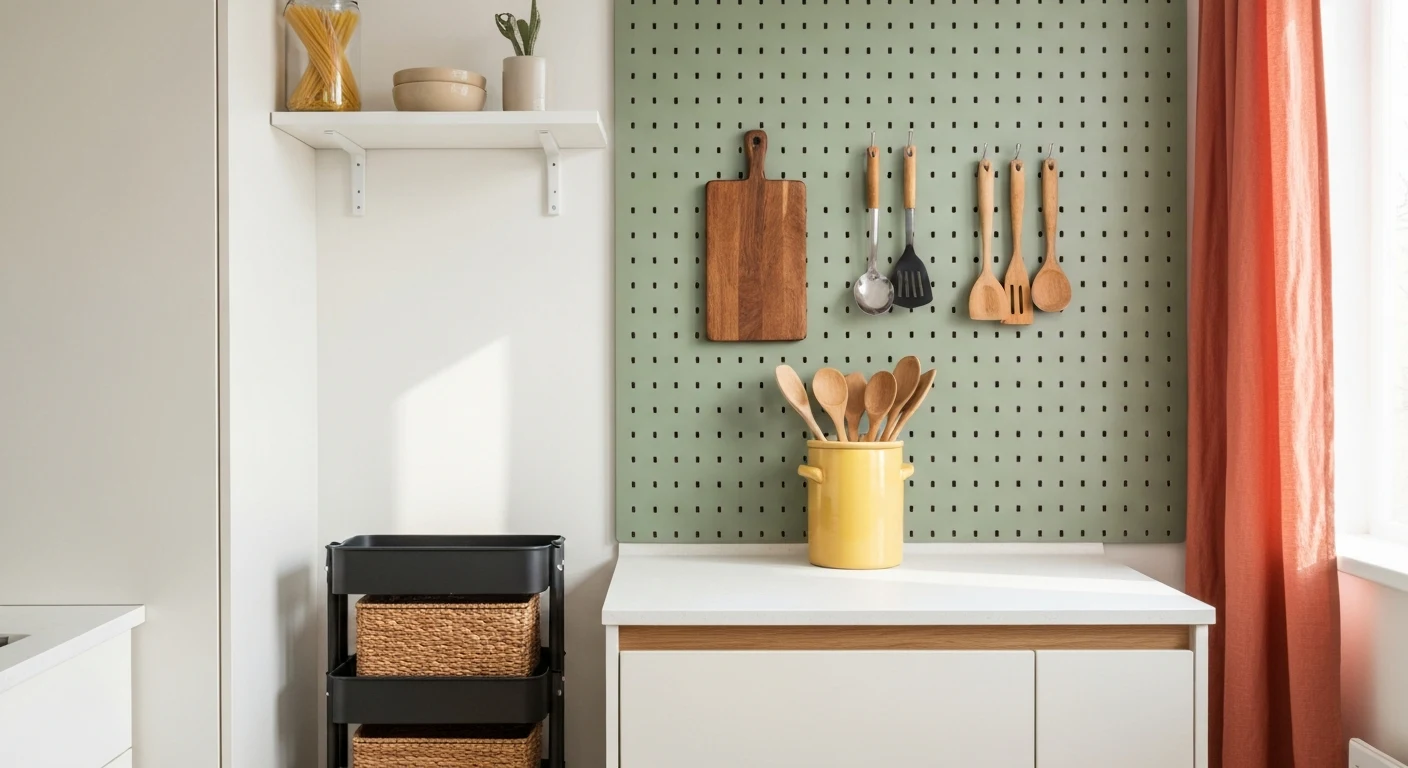
The single most undervalued surface in an apartment kitchen is the wall between the upper cabinets and the counter (the backsplash zone) and any blank wall next to the fridge or stove. Most renters leave these walls empty because they came empty, but a $40 magnetic knife strip, a $25 spice rail, or a $60 pegboard converts dead drywall into 8 to 12 linear feet of usable storage without a single new drilled hole if you use 3M Command strips or tension-mounted hardware. The walls add what cabinets do not give you.
The five vertical storage formats that work in any rental:
- Magnetic knife strip ($20-50). A 12 to 18 inch magnetic bar mounts under upper cabinets or on the backsplash with adhesive or two screws. Holds 6 to 10 knives, frees the drawer, keeps blades visible and dry. The format that pays back fastest.
- Wall-mounted rail system ($30-80 per 18 inches). IKEA HULTARP or KUNGSFORS rails, or a comparable Container Store / Amazon system. Hangs utensils, S-hooks, small baskets, hanging bars. Mount with adhesive strips under upper cabinets if drilling is off-limits.
- Pegboard panel ($30-80 for a 24x36 inch panel). The classic. Hang utensils, pots, cutting boards, a roll of paper towels, and reposition every season as your needs change. Mount with French cleats or 3M heavy-duty strips for renter-friendly installation.
- Over-the-counter floating shelf ($25-60 per shelf). One or two shallow (6 to 8 inch deep) floating shelves above the counter hold glass canisters, ceramic crocks, plants, and the daily coffee setup. Use heavy-duty wall anchors or rail-shelf systems that distribute load.
- Side-of-fridge magnetic organizer ($15-40). The most-overlooked square foot in any kitchen. A magnetic spice rack, paper towel holder, or 3-tier magnetic basket on the side of the fridge gives you 4 to 6 square feet of storage you currently waste.
NKBA's 2026 Kitchen Trends Report (634 industry professionals, 57% designers) found 70% of designers report homeowner requests for "smarter storage" with floor-to-ceiling cabinetry, walk-in pantries, and refrigerators with custom configurations leading the list. Renters cannot do floor-to-ceiling cabinetry, but the vertical-rail playbook gets you 60% of the benefit at 5% of the cost. For the broader renter-friendly mounting playbook (which adhesives work on which surfaces, which leave residue), my renter-friendly wall decor guide covers the no-damage hardware in detail.

Pull-Out and Drawer Inserts: The Highest-ROI Add-On
If you own the apartment, or if your landlord allows non-permanent insert modifications, pull-out drawer organizers are the single highest-return-on-investment storage upgrade per dollar. They convert deep, hard-to-reach base cabinet space into front-accessible storage, recovering roughly 40% of the cabinet's volume that was previously unreachable. The Houzz 2026 study reported 64% of renovating homeowners install pull-out waste and recycling bins, 55% add tray and cookie sheet dividers, 41% add spice drawers, and 38% add cutlery dividers. The Houzz percentages are the ranking of which pull-outs add the most usable space per dollar.
Angi reports in its 2026 cost survey that soft-close drawer slides installed in existing cabinets run $40 to $100 per drawer in labor, with the slide hardware itself costing $25 to $80. A full base cabinet conversion (4 to 5 drawers replacing one cavernous shelf) lands at $300 to $600 installed. Compare that to the Houzz 2025 median high-end kitchen remodel of $60,000 and the math is obvious: insert upgrades give you 60 to 70% of the storage gain of a full remodel for 1% of the cost.
Six pull-out and insert formats ranked by space recovered per dollar:
- Wire pull-out shelves for base cabinets ($25-60 per shelf). Mount on existing cabinet floor with two screws (or screw-free pressure-fit models that sit on the shelf without hardware). Convert a deep dark cavern into two accessible levels. The cheapest single upgrade.
- Pull-out trash and recycling bin ($60-180). Houzz's #1 specialty storage feature for a reason. Hides ugly bins, frees floor space, and stops the lid-slamming. Single or double bin formats.
- Vertical tray and cookie sheet divider ($30-80). Slot dividers that let you store baking sheets and cutting boards vertically instead of stacked. Pulls a 6-baking-sheet stack from 12 inches of horizontal space into 2 inches of vertical space.
- Spice drawer insert with angled slots ($25-70). 1.5 inch deep drawer inserts with angled slots that hold 24 to 36 spice jars at a glance. Beats spinning spice racks in cabinets, which lose half the jars to the back.
- Lazy Susan corner pull-out ($60-300). Activates the blind corner cabinet that holds a black hole of forgotten Tupperware. Half-moon swing-out shelves cost $60 to $150; full pull-out kidney shelves $150 to $300 installed.
- Cabinet door-mounted spice and tool rack ($15-45). Hangs inside any cabinet door. Holds 8 to 15 spice jars or kitchen tools. Pure new storage with no donor cabinet space lost.
For renters, the door-mounted and pressure-fit options are the only ones that work without drilling. For owners or long-term tenants with permission, the full pull-out conversion is the move I would prioritize over any aesthetic upgrade. The NAR 2025 Remodeling Impact Report ranked kitchen upgrades with a perfect Joy Score of 10/10 (tied with primary bedroom suites and new roofs, the highest score in the report), and 48% of Realtors reported a year-over-year jump in client demand for kitchen renovations, the largest demand jump of any project category in the 2025 survey. Pull-out inserts are the part of that renovation that delivers daily joy, not the marble.
Convert Dead Zones: Corners, Above-Cabinet, Toe-Kicks
Every apartment kitchen has at least four dead zones the builder ignored: the upper cabinet corner that nothing fits in, the space above the cabinets (the soffit zone), the side of the fridge facing the wall, and the toe kick under the base cabinets. Together these zones hold 8 to 15 cubic feet of unused volume in a 70 square foot kitchen, and renters can activate three of the four without any permanent modification.
The dead-zone playbook by location:
- Blind corner cabinets. The upper or lower cabinet where the L-turn happens. Half the volume is unreachable. Fix: lazy Susan turntable ($15 to $40 for a 12 inch model, $40 to $80 for tiered versions) on the existing shelf, no installation needed. Owners can install a swing-out shelf system for $80 to $200.
- Above-cabinet (soffit gap). 12 to 18 inches between the top of the upper cabinets and the ceiling. Renters: stack 2 to 3 woven baskets ($20 to $40 each) for seasonal/rare items like the turkey roaster or holiday platters. Owners: build a flat shelf at the soffit line for cookbooks and display.
- Side of fridge. The side facing the wall is almost always wasted. A 24 inch tall slim rolling rack ($35 to $90, usually 4 to 8 inches wide) slides into the gap and holds spices, oils, foils, and baking sheets vertically. Pure new storage from a forgotten 6 to 12 inches of width.
- Top of fridge. Most fridges have 12 to 24 inches of clearance to the ceiling. Two woven baskets or a tray with infrequent appliances (waffle iron, ice cream maker) fills it. Add a furniture strap to anchor heavy items if you have small kids or live in an earthquake zone.
- Toe-kick (under base cabinets). 3 to 5 inches of vertical space at the floor of every base cabinet run. Owners can install custom toe-kick drawers ($150 to $400 each, perfect for storing flat trays, baking pans, and dog food bowls). Renters cannot easily access this without removing the toe-kick board.
- Under-sink vertical zone. The pipe under the sink eats half the cabinet, but the space around it is still usable. A two-tier sliding under-sink shelf ($25 to $50) doubles the usable volume by clearing the pipe.
The above-cabinet zone is my favorite recovery target because it is invisible to the eye-line and large enough to hold the rare-use items that clutter prime drawers. Three woven baskets at $25 each gives you 6 cubic feet of new storage for $75. The toe-kick zone is the only one I would skip as a renter; the work-to-payoff ratio is bad without owning the cabinets. For more on the layout side of small-kitchen optimization, the how to make a small kitchen functional guide covers the work-triangle and counter-flow logic.
Pantry Without a Pantry: Slim Rolling Carts and Door-Back Organizers
"I just need a pantry" is the most common request in any small-kitchen-storage forum, and it is also the easiest to fake. A studio or one-bedroom apartment without a dedicated pantry can still get 6 to 10 linear feet of pantry-equivalent storage by stacking three formats: a slim rolling cart, a door-back organizer, and a single tall freestanding shelf in a corner or hallway. Total cost: $80 to $250. Total footprint: 4 to 6 square feet. The NKBA 2026 report flagged walk-in and butler's pantries as part of its "smarter storage" 70% finding, and 66% of design professionals predict pantries will be the dominant kitchen storage format in the next 3 years. Renters cannot build a butler's pantry, but the rolling-cart workaround captures 70% of the benefit at 3% of the cost.
The pantry-replacement stack:
- IKEA RÅSKOG or comparable 3-tier utility cart ($35-75). 13 inches wide, 17 inches deep, 32 inches tall. Holds 3 tiers of pantry overflow: canned goods on the bottom, baking on the middle, dry goods on top. Wheels in and out from a corner or under a counter. The single most-recommended storage purchase in any small-kitchen subreddit.
- Over-the-door pantry organizer ($25-70). Hangs on the inside of any pantry or closet door with no drilling. 4 to 6 shelves, 6 to 8 inches deep, perfect for spices, snacks, cleaning supplies, and dry goods. Adds 4 to 8 square feet of pantry-equivalent space.
- Tall freestanding shelf unit ($60-180). A 12 to 18 inch wide, 6 foot tall metal or wood shelf in a corner of the dining area, hallway, or unused wall. Holds the entire dry-goods inventory of a small household: 60 to 80 jars and cans, 20 to 30 cooking accessories. The biggest pantry-equivalent move.
- Slide-out pantry pull-out (between fridge and wall) ($80-250). A 4 to 8 inch wide pull-out rack that slides into the gap between the fridge and the wall. Holds 30 to 60 cans and spice jars in a slot most kitchens leave empty.

The reason the rolling cart works better than building shelves on the wall is that the cart moves out of the way when you need the floor for cooking or hosting. The reason the freestanding shelf works better than buying a free-floating cabinet is that it sets up in 30 minutes, leaves no marks, and goes with you to the next apartment. Both are scalable: start with the cart at $40, add the door organizer at $25 next month, and add the freestanding shelf when the budget allows. The full pantry stack lives in any apartment under 800 square feet without needing a single drilled hole.
The Glass Container Shift: Why Plastic Tupperware Is on the Way Out
Food storage containers are the most-replaced kitchen category right now, and the shift is from plastic to glass, steel, and bamboo. GMInsights' April 2025 Food Storage Container Market Report valued the global market at $163.5 billion in 2024 with a 4.5% CAGR through 2034 (reaching $247.29 billion by 2034), and 40% of consumers actively choose eco-friendly alternatives like glass, stainless steel, and bamboo over plastic. Reusable glass and metal containers grew their market share from 18.5% to 24.2% in three years.
The health driver is real. A March 2024 study published in Environmental Science & Technology (American Chemical Society) found microwaving food in plastic containers releases up to 4.22 million microplastic particles and over 2 billion nanoplastic particles per square centimeter in a single 3-minute heating session. The microplastic data hit consumer awareness fast, and Google search trends for "glass food storage containers" have run 30 to 50% above baseline since the study was widely covered in late 2024.
The practical container buying guide for a small kitchen:
- Square over round. Square containers tile against each other and against the cabinet wall. Round containers leave triangular gaps. A 12-piece square glass set stores in 30% less shelf footprint than the equivalent round set.
- Nesting matters more than capacity. A 7-piece glass set that nests inside itself when empty takes 25% of the storage space of a non-nesting set. Pyrex, Glasslock, and Anchor Hocking all sell nesting versions.
- One size of lid for the whole set. Mixed lid sizes are why everyone has a drawer of orphan tops. Buy a set with three or four total lid sizes; the drawer dividend is immediate.
- Glass weight is a real factor on shelves. A 5-cup glass container weighs roughly 1.5 to 2 pounds empty. A full shelf of 8 glass containers can exceed 25 pounds, which is the practical safe load for most apartment shelves. Spread the load or upgrade the shelf hardware.
- Build the set in two phases. Buy a 6-piece set first ($25-50) to cover daily leftovers, then add a 6-piece set six months later for batch cooking. Avoid the 30-piece mega set; you will not use 18 of them.
Container storage is the only category in this guide where I recommend buying twice. The first set tests how you cook; the second set fills in what worked. A $30 starter set plus a $40 expansion six months later beats a $90 mega set bought once. The other category note: pair glass containers with bamboo lids or silicone seals rather than plastic for the full benefit; some glass sets ship with plastic lids that defeat the microplastic concern.
Smart Kitchen Tools That Help (And the Ones That Don't)
The smart kitchen appliance category hit $17.3 billion globally in 2024 and is forecast to reach $62.4 billion by 2034 at a 13.7% CAGR (GMInsights, 2025), with smart refrigerators holding roughly 34% market share. For renters, almost all of the smart-fridge premium is wasted: you cannot take a $3,000 smart refrigerator with you, and the apartment building's existing fridge is not getting replaced. The tools worth buying are the cheap, portable ones.
- Inventory app on your phone (free). Out of Milk, Pantry Check, or AnyList tracks what is in your pantry, what is running out, and what is about to expire. Saves the "do I have flour?" trip during a recipe.
- Wi-Fi instant pot or air fryer ($80-200). A 6-quart instant pot pulls double duty as rice cooker, slow cooker, yogurt maker, and pressure cooker, replacing 4 single-function appliances and reclaiming a base cabinet's worth of storage.
- Label printer ($50-120). A Brother P-Touch or Niimbot mini label printer. Labels every container, jar, and shelf in 10 minutes. The single biggest organization tool no one talks about, and it pays back the first time you find the cinnamon in 5 seconds instead of 5 minutes.
Skip smart refrigerators (sunk cost in someone else's appliance), Wi-Fi spice racks ($300 to track 24 jars is absurd), and induction-only smart cooktops. Spend the budget on the inventory app and the label printer; both move with you, and both deliver compounding returns. For the broader productivity playbook of small-space living, my multifunctional furniture for small apartments guide covers the indoor-side equivalent of "pieces that earn their footprint."
The Real Cost of Disorganization (And What Renters Spend to Fix It)
The case for spending $100 to $800 on storage gear in a kitchen you do not own rests on three numbers. First, the Pixie 2017 Lost & Found Survey: $2.7 billion annually wasted on replacement costs for items Americans misplaced at home, with kitchen items leading the categories. Per household, the annual cost is roughly $235 in replacements plus 60 hours of search time.
Second, the Saxbe and Repetti 2010 cortisol study (UCLA, published in Personality and Social Psychology Bulletin) followed 30 dual-earner Los Angeles households and measured diurnal cortisol patterns against home tour transcripts. Women who described their homes using clutter-related words showed flattened cortisol slopes, a stress-hormone profile linked to chronic adverse health outcomes, even after controlling for marital satisfaction and neuroticism. The study is the standard cite for the physiological cost of clutter, and the kitchen drives most of the clutter-related stress in the survey.
Third, the USDA Economic Research Service Food Expenditure Series. Real US food-away-from-home spending grew 3.0% in 2023 but only 0.4% in 2024, and a Flashfood/Talker Research 2024 survey found 78% of US consumers eating at home more often in 2025 to save money. Cooking at home is up, kitchen space is not. The BLS American Time Use Survey 2024 reports Americans 15 and older spend 40 minutes a day on food preparation and cleanup (0.67 hours), totaling roughly 244 hours per year. Cutting 5 minutes a day off "where is the spatula" gives you back 30 hours a year, a free vacation week of evenings. Pinterest's 2026 Spring Trend Report tracks the search side: "color drenching kitchen" rose 125%, "kitchen lighting plan" 165%, and "kitchen countertop decor" 190% year over year. The kitchen-makeover wave hits renters and owners alike, and storage gear is the part of the makeover that gives daily returns.

Three Complete Setups by Budget ($75, $300, $800)
Below are three full small-kitchen storage setups at three real-world budgets, drawn from current retail at IKEA, Container Store, Amazon, Target, and Home Depot. All three can be assembled in one weekend and require zero drilling or permanent damage. The Angi 2026 cost data backs the high-end budget ($40 to $100 per drawer for soft-close pull-out installation), and the rest comes from direct retail pricing.
Setup 1: Renter Starter ($60-75). One IKEA RÅSKOG 3-tier rolling cart ($35-45), one magnetic knife strip ($20-30), one over-the-door pantry organizer ($20-25), and four medium glass jars for spices ($12-20). Total footprint: 6 square feet. Time to set up: 90 minutes. The setup I would tell any 22-year-old in their first studio to buy on day one of move-in. Covers daily-access, pantry-equivalent storage, and wall-mounted knife storage with zero damage.
Setup 2: Renter Comfort ($250-300). Everything in Setup 1, plus: one tall freestanding metal shelf unit ($60-100), one pegboard panel with hooks ($40-60), one set of 6-12 nesting glass containers ($45-75), one drawer divider set ($25-40), one lazy Susan turntable ($20-30), and a label printer ($50-70). Total footprint: 10-12 square feet. Time to set up: 4 hours. The setup that turns a 70 square foot apartment kitchen into a functional cooking space for a couple or a family.
Setup 3: Owner-Occupier Invest ($650-800). Everything in Setup 2, plus: pull-out drawer slide installation on 4 base cabinets at $40-100 per drawer ($160-400 installed, Angi 2026 data), pull-out trash and recycling cabinet ($120-200 installed), spice drawer insert ($30-70), and corner cabinet swing-out shelf ($80-150 installed). Total footprint: same as Setup 2 (the upgrades are inside the existing cabinets). Time to set up: weekend of DIY or a 1-day pro install. The setup that recovers the 40% of base cabinet volume the builder left dead, and the one I would prioritize over any aesthetic kitchen upgrade short of repainting cabinets.
The setup that pays back fastest is whichever one you finish within the first month. NAR's 2025 Remodeling Impact Report finding (perfect 10/10 Joy Score for kitchen upgrades, the highest in the survey) tracks the storage side, not the marble side. Storage upgrades show up every morning when you reach for a coffee mug and it is exactly where it should be. The pretty side is a one-time photograph; the storage side is a daily dividend. For broader small-space planning that connects kitchen organization to the rest of the apartment, the how to decorate a studio apartment pillar guide covers the layout-and-zoning logic for the whole unit. And the small closet organization ideas guide applies the same vertical-storage logic to the bedroom side of the same apartment.
Frequently Asked Questions
What is the cheapest way to add kitchen storage to a rental?
An IKEA RÅSKOG 3-tier rolling cart ($35-45) and a magnetic knife strip ($20-30) are the two single purchases that recover the most storage per dollar in a rental. The cart adds 3 levels of pantry-equivalent space and rolls out of the way when not in use; the knife strip frees a drawer and a counter spot. Total cost under $75 with no drilling required. Add an over-the-door pantry organizer for another $25 and you have the renter starter kit covered.
How do I organize a kitchen with no cabinets at all?
Studio kitchens with one or zero upper cabinets are common in pre-war buildings and converted lofts. The fix is a tall freestanding shelf unit (6 foot, 12-18 inches wide, $60-180), a pegboard wall for hanging cookware and utensils, and a slim rolling pantry cart. Together these add 8 to 12 linear feet of storage in roughly 6 square feet of floor space. NKBA's 2026 trends report flags floor-to-ceiling vertical storage as the dominant solution, and the renter version uses freestanding furniture instead of built-in cabinets.
Are pull-out drawer inserts worth installing in a rental?
Only the no-screw, pressure-fit pull-out inserts work in a typical rental without lease concerns. These cost $25-60 per shelf, sit on existing cabinet floors, and pull out 70% of the cabinet's depth. They recover 30 to 40% of dead base-cabinet space without modifying the cabinet. Soft-close screw-installed pull-outs ($40-100 per drawer per Angi 2026) are owner territory and worth installing if you plan to stay 3+ years; the resale Joy Score data from NAR's 2025 Remodeling Impact Report (perfect 10/10) supports the investment.
What is the best food storage container material?
Glass with bamboo or silicone lids is the current best-balance choice for small kitchens. GMInsights' 2024 Food Storage Container Market Report shows the eco-friendly material share (glass, stainless steel, bamboo) grew from 18.5% to 24.2% over 3 years, driven by a March 2024 ACS Environmental Science & Technology study showing plastic containers release 4.22 million microplastic particles per square centimeter when microwaved. Glass also stacks tighter, lasts longer, and resists stain and odor. Square nesting sets store in 30% less shelf footprint than round.
How much do I have to spend to make a small kitchen functional?
Roughly $60-75 for the renter starter setup (rolling cart, knife strip, door pantry organizer, glass jars) gives you the bare minimum to cook daily without losing things. $250-300 for the renter comfort setup adds wall pegboard, freestanding pantry shelf, full container set, and a label printer. $650-800 for the owner-occupier setup adds installed pull-out drawer inserts, recovering 40% of dead base-cabinet space. The cost-per-month-of-use math favors the $250-300 setup for most renters: roughly $10-12 per month over a 2-year lease.
Where do I put a microwave when there is no counter space?
Three options, ranked by space savings. First, a microwave shelf bracket mounted on the wall above the counter ($30-60, requires 2 wall anchors but otherwise renter-acceptable). Second, an over-the-range microwave swap if the landlord allows (provides vent function plus storage). Third, a slim countertop microwave (15-17 inches wide vs the standard 20-24 inches) on a tall freestanding shelf, freeing 12 inches of counter run. Avoid built-in trim kits; they are owner-only and lock you into one appliance size.
Small-kitchen storage comes down to four moves: empty the cabinets and audit by frequency, use every wall and door surface available, activate the dead zones (corners, above-cabinet, side-of-fridge), and replace plastic with nesting glass once the system is set. Get those four right and a 70 square foot rental kitchen becomes a functional cooking space for a couple, not a daily frustration. The NKBA 2026 finding that 70% of remodel requests now lead with "smarter storage" matches what renters have been doing with rolling carts and pegboards for a decade; owners are catching up to the renter playbook. For the design and decor side of finishing the same space, the how to decorate a small kitchen guide covers color, lighting, and the visual tricks that make a tight kitchen feel twice as big. And for the cabinet face and backsplash side, the kitchen backsplash ideas for small kitchens guide covers the surfaces above the storage you have built.
Tags

Written by Joesp H.
Interior Design & Small Space Living Specialist
Former marketing manager turned full-time home optimizer. After living in 7 homes ranging from 450 to 2,000 sq ft, I started CleverSpaceSolutions to help people create organized, functional spaces on real budgets.
Other Articles

How to Create a Stylish Entryway When Your Apartment Doesn't Have One
5 renter-friendly entryway setups for apartments with no foyer. Console tables, floating shelves, bench-and-hooks, bookshelf mudrooms, and rug-defined entries from $5 to $100.
Kitchen Backsplash Ideas for Small Kitchens: Budget-Friendly Designs That Pop
12 budget-friendly backsplash ideas for small kitchens, from 0 painted walls to 80 subway tile. Real costs, DIY timelines, and renter-friendly options with sourced data.

How Can You Make a Small Kitchen Look More Stylish? 10 Designer Ideas
Looking for unique ways to improve your small kitchen? This guide answers your questions with 10 designer-inspired ideas, from ceiling racks to clever lighti...